Posts

Showing posts with the label Budgets

The Future United States Navy Surface Fleet (2020-2040)

Image
With the US Navy's fiscal year 2021 budget proposal being recently released, combined with the latest news that the USN has dropped its previous plan to extended the service lives of its cruisers and destroyers to a historically unrealistic 45+ years, I thought I'd put up a quick post showing the likely future of the USN's surface fleet. Before delving deeper into the above graph, I should first make clear that the budget documents only give (somewhat) hard numbers on annual deliveries out to around FY2027, and everything past FY2031 is entirely my own projection. The assumptions I made are that CG/DDG retire after 35 years, LCS last 30 years, DDG and FFG production both stabilize at 2 ships annually, that 22 Arleigh Burke Flight III are procured to replace the Ticonderoga-class 1 for 1, and that the Future Surface Combatant phase in mirrors the planned LCS to FFG(X) transition. However, different assumptions will not change the overall shape of the future force...
Aircraft Carrier Costs: Nimitz vs Ford

Image
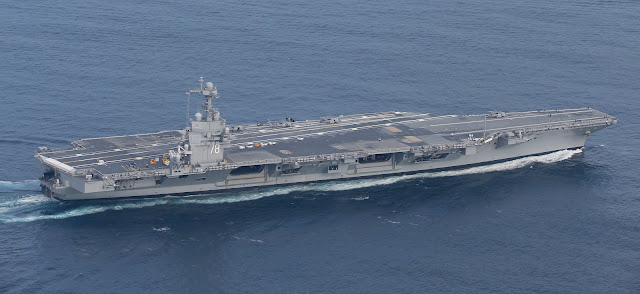
The much-maligned USS Gerald Ford (CVN-78) The United States Navy's new Gerald Ford -class aircraft carriers, like virtually all modern military equipment, have come under intense criticism for their supposedly exorbitant cost. Accusations of their costing 2-3 times as much as their predecessors, the venerable  Nimitz -class have been thrown around and many believe that the Navy would have been better off not developing the Gerald Ford -class. However, I believe these criticisms are entirely unjustified and (as with the F-35, which I previously wrote about ) stem from the media's ignorant if not outright dishonest use of non-comparable costs and a poor understanding of timelines. When put into proper context, I believe that the ships of the  Gerald Ford -class are actually only marginally more expensive than those of the Nimitz -class. First the numbers. The Navy's budget submissions reveal the exact costs of three carriers: the final member of the  Nimitz -clas...

FY2020 US Navy Budget Highlights

The recent United States Navy Fiscal Year 2020 budget proposal has unleashed the usual flurry of articles analyzing and discussing its ramifications. However, while the vast majority of these have focused on the same details, particularly the proposed early retirement of USS Harry Truman (CVN-75) and the introduction of large unmanned surface vessels, I will instead point out various minor pieces of information that have caught my eye. Missiles The greatest change is that antiship missiles are indeed back with a vengeance. In FY20, the Navy is proposing to procure no fewer than 216 antiship missiles of 5 different types and has stated a desire for an overall inventory of over 2000 dedicated antiship missiles. This is quite obviously aimed at the rapidly growing Chinese Navy. However, by my rough estimation, this is actually enough weapons to sink every non-US warship in the word twice over. Tomahawk Tomahawk production is restarting after a lapsing for FY19. A total of 180 weapon...

Royal Navy vs United States Navy (2018)

Image
Despite the title, this post is not about a hypothetical battle between the United States Navy and the Royal. Instead, it is an attempt to analyze how accurate Britain’s common refrain about “punching above its weight” really is. While my thesis may prove unwelcome to the British, I am not trying to insult the RN. Rather, I am trying to disabuse a commonly held myth that I feel does far more harm than good. First a comparison of the two nations. The UK has a population of 66m and a GDP of $2.9 trillion nominal or $3.0 trillion PPP, while the US population is 327m and its GDP is $20.4 trillion (nominal and PPP are the same for the US since PPP is calculated off the dollar). Supported by a population 1/5 the size and a GDP 1/6.8 times the size, it is obvious that the UK will be far weaker than the US in absolute terms. However, as will be shown, it is also far weaker in relative terms. The FY2018, the British defense budget was £47.2 billion ($62.5 billion at the time of posting), ...

Procurement Perspective: F-35C Lightning vs F/A-18E/F Super Hornet

Image
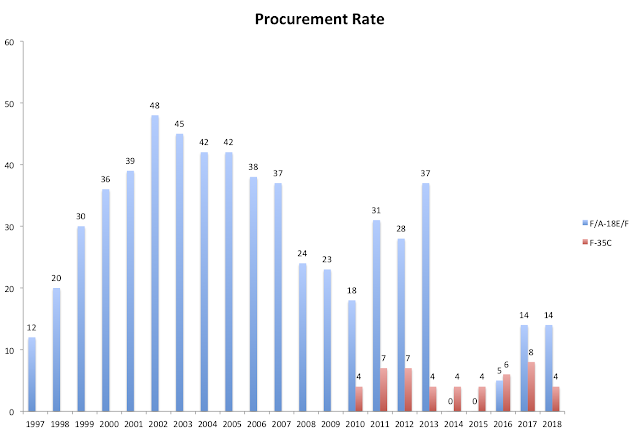
The F-35 Lightning II Joint Strike Fighter is certainly one of today's most controversial procurement programs and is widely criticized for its extreme cost. In contrast, the F/A-18E/F Super Hornet is widely touted as an example of cost management and military procurement done right. But what happens if you dig a little deeper into the history of these two programs? The first thing that must be done is to understand the timelines of the two programs. Because both aircraft are currently being procured (the FY2019 Navy budget requests twenty four Super Hornets and nine Lightnings), there is a tendency to think of the two planes as near contemporaries. However, this is far from true. The first F/A-18E/F prototype was ordered in 1992 and made its first flight in 1995, while for the F-35C those dates were 2007 and 2010. Procurement of both aircraft began in the same year that the prototype first flew. To put this into perspective, fifteen years separated the first flights of the Sup...

The Cost of a Warship and Some Thoughts on FFG(X) (2018)

Image
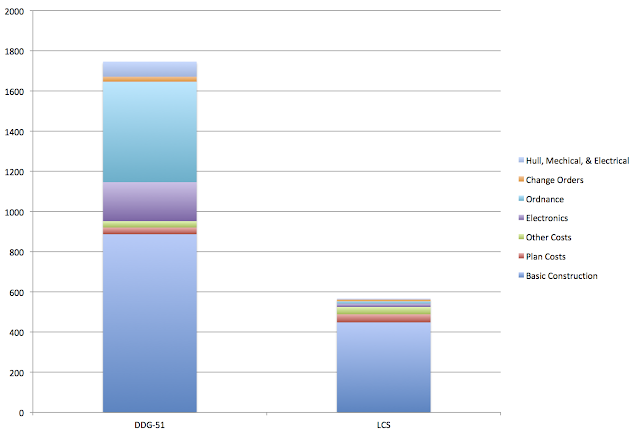
As the US Navy's FFG(X) program heats up, I've been digging through the Navy's FY19 budget submission to get an idea of various costs trade offs involved in designing a modern "medium end" warship. While none of the information that I have found is particularly revolutionary, I thought I would post my conclusions were still worth posting. Today, the Navy only has two active production lines for surface combatants - the DDG-51 Flight III  Arleigh Burke  and the LCS Flight II Freedom / Independence . However, since these two designs are on opposite ends of the spectrum (one widely acknowledged as the most capable warship in the world and the other routinely criticized for its lack of capability), comparing them directly is remarkably valuable. A DDG-51 Flight III has an official Gross Unit Cost of $1,747 million while an LCS Flight II is $565 million (all figures in this post are an average of the 7 DDG or 6 LCS in FY17-19). However, the actual amount spent p...