Posts

Showing posts with the label World Navies

Royal Navy vs Marine Nationale (2025)

Image
Two of the greatest navies in Europe have long been the British and the French. For most of their history, these two navies have been competitors, facing off in numerous wars from the Battle of Sluys in 1340 to the Attack on Mers-el-Kebir in 1940 (it is worth noting that, as was often the case in conflicts between these two great navies, the British triumphed in both the first and last of these actions). However, as Britain and France were eclipsed by rising powers outside of Europe during the 19th and 20th centuries, the Royal Navy and Marine Nationale slowly became partners rather than rivals. From the Anglo-French blockade of the Río de la Plata in 1845 and the Second Opium War in 1856 to the Suez Crisis of 1956, the British and French navies worked effectively together to project power abroad. Still, declining national strength during the Cold War saw both navies largely relegated to auxiliary forces under the umbrella of the United States Navy. While the Royal Navy saw a brief fli...

World Navies of 2021

Image
HMS Spey , the latest addition to the Royal Navy. While often underappreciated, offeshore patrol vessels like her are critical to projecting naval power at home and around the world. World Navies in the New Year For a much-delayed first post of the new year, we have the official Influence of History  2021 World Navy Rankings. As always, this ranking system attempts to provide an overview of the relative naval power of the world's nations by listing their naval inventories and providing a somewhat relative points value. Because of the contentious nature of warship classification, I have resorted to my own fairly simplistic, but universal, system that classifies ships based on size and type. Points are determined based on the number and type of ships. While my system does attempt to capture total national naval power by including coast guard ships and other government vessels, it does not count coastal craft outside of missile boats and minesweepers. The points system has remained fa...

World Aircraft Carriers (1951 - 2020)

Image
All non-US carriers operating fixed-wing aircraft (click to enlarge) The aircraft carrier has been the ultimate expression of naval power since World War II. Able to engage air, surface, and subsurface targets from hundreds of miles away, the carrier is a highly versatile class of warship and even a small number of carriers can turn the tide of an entire war. However, these ships (and the aircraft that they carry) are extremely expensive and only a handful of navies have ever operated them. Since the end of World War II, only 14 nations have operated a carrier with fixed-wing aircraft and no more than 9 nations have done so simultaneously. The above chart covers all non-US aircraft carriers operating fixed-wing aircraft from 1951-2020. I have not only excluded helicopter carriers, but also attempted to avoid counting commissioned ships that did not have available aircraft (for instance, I did not count the Soviet Kiev-class ships after 1991, when their Yak-38 fighters were phased out)...

World Navies of 2020

Image
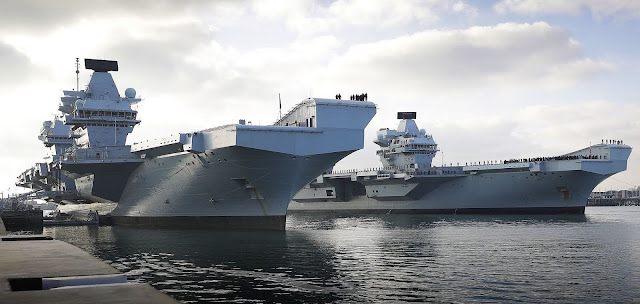
Among the greatest changes over the past year was the commissioning of the Royal Navy's second carrier,  Prince of Wales - an event   perhaps slightly overshadowed by the commissioning of the PLAN's second carrier, Shandong, just seven days later . As we begin the new year, it is a good time to assess the current naval balance of power. However, ranking navies is always a complex and subjective task as even something as simple as merely counting how many ships a navy has soon devolves into debates over what exactly constitutes a "ship" (just look at the never-ending battle over what should be included in the US Navy's official strength). Observing these debates, I have devised my own system for quantifying a navy's strength. This system classifies vessels into broad categories, assigning different (and admittedly somewhat arbitrary) points values for different types of ships. In order to avoid terminology debates, I have also used more generic labels (...

World Navies of 2019

Image
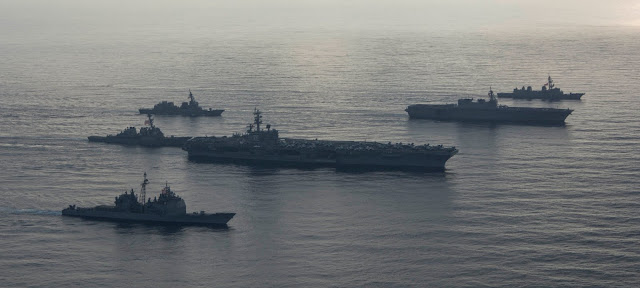
American and Japanese warships conducting exercises in the South China Sea The following is an inventory and ranking of every navy of note in the beginning of 2019. Unlike most rankings, which only consider combat power, this ranking attempts to consider the entire fleet of each nation. Ships not included in the following rankings include auxiliaries and landing ships of less than 100 meters, combatants without missiles of less than 75 meters, and missile boats and mine countermeasures vessels of less than 25 meters. Given the diverse sizes and capabilities of the various ships of the world and the lack of any globally accepted system of classification, I have have eschewed traditional labels (i.e. cruiser, destroyer, frigate) in favor of more general descriptions (i.e combatant). For the sake of easy comparison, I have also given each navy a points value. This value is purely based on how many ships of each type the navy possess, with different amounts of points given for dif...