Posts

Showing posts with the label France

Royal Navy vs Marine Nationale (2025)

Image
Two of the greatest navies in Europe have long been the British and the French. For most of their history, these two navies have been competitors, facing off in numerous wars from the Battle of Sluys in 1340 to the Attack on Mers-el-Kebir in 1940 (it is worth noting that, as was often the case in conflicts between these two great navies, the British triumphed in both the first and last of these actions). However, as Britain and France were eclipsed by rising powers outside of Europe during the 19th and 20th centuries, the Royal Navy and Marine Nationale slowly became partners rather than rivals. From the Anglo-French blockade of the Río de la Plata in 1845 and the Second Opium War in 1856 to the Suez Crisis of 1956, the British and French navies worked effectively together to project power abroad. Still, declining national strength during the Cold War saw both navies largely relegated to auxiliary forces under the umbrella of the United States Navy. While the Royal Navy saw a brief fli...

World Aircraft Carriers (1951 - 2020)

Image
All non-US carriers operating fixed-wing aircraft (click to enlarge) The aircraft carrier has been the ultimate expression of naval power since World War II. Able to engage air, surface, and subsurface targets from hundreds of miles away, the carrier is a highly versatile class of warship and even a small number of carriers can turn the tide of an entire war. However, these ships (and the aircraft that they carry) are extremely expensive and only a handful of navies have ever operated them. Since the end of World War II, only 14 nations have operated a carrier with fixed-wing aircraft and no more than 9 nations have done so simultaneously. The above chart covers all non-US aircraft carriers operating fixed-wing aircraft from 1951-2020. I have not only excluded helicopter carriers, but also attempted to avoid counting commissioned ships that did not have available aircraft (for instance, I did not count the Soviet Kiev-class ships after 1991, when their Yak-38 fighters were phased out)...

World Carrier Air Wings (2019): Part 1

Image
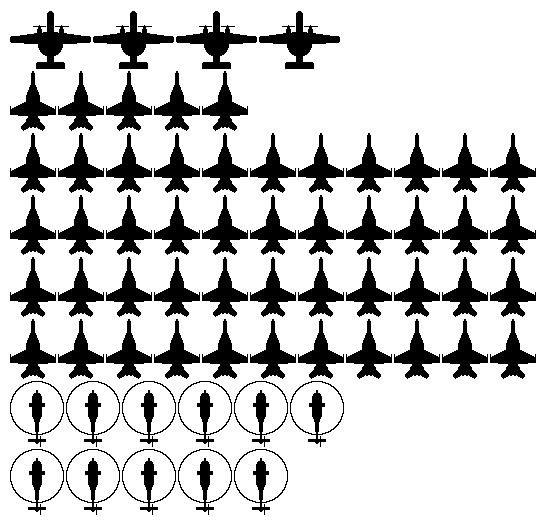
This post will cover the composition of the air wings of the world's current major aircraft carriers. This includes the American Nimitz -class, the French Charles de Gaulle , the Chinese Liaoning , the Indian Vikramaditya , and the Russian Kuznetsov . The air wings of the smaller VSTOL are covered in Part 2 . Nimitz-class The uncontested apex of carrier air wings is found aboard the United State’s 10 Nimitz -class carriers (the Gerald Ford -class will carry the same air wing, although the lead ship is not yet operational). These ships generally operate 64 aircraft, twice as many as their competitors. Further, unlike almost all non-American carriers, the Nimitz-class is equipped for catapult takeoff and arrested recovery (CATOBAR), permitting the operation of heavy aircraft with full loads of weapons and fuel. 2019 Nimitz-class air wing: 4x E-2D, 5x EA-18G, 44x F/A-18E/F, 11x MH-60R/S Arguably the most important aircraft in this air wing are its 4 the E-2 Hawkeye 29-ton fi...

Missile Loadouts: French Air Warfare Ships (1962-2018)

Image
The Marine Nationale has a somewhat mixed history with guided missile ships. It obtained its first such ship back to 1962, the same year as the Royal Navy. Further, France has domestically designed and produced two generations of naval surface to air missiles. However, every class of French guided missile ships was cut short for budgetary reasons, resulting in a perpetually undersized fleet, and none of these ships has every fired a missile in anger, leaving their actual combat effectiveness open to question. Surcouf-class The first French guided missile ships were conversions of the  Surcouf -class escorteurs d'escadre. Originally armed with a heavy battery of six 5" and six 57mm guns, the twelve ships of the Surcouf -class were the first French destroyers built after WWII and entered service 1955-1957. While France already had an indigenous naval missile program, the United States offered to supply a number of Tartar missile systems free of charge. Four ships were selected ...

Average Warship Age (2018)

Image
This began as a quick look at the average age of the warships of the Russian navy, but the results were interesting so I expanded it to include the top dozen navies. For simplicity's sake, I only considered the following vessels: carriers (including flattop amphibious ships), submarines (excluding ballistic missile submarines), and surface combatants of over 100 meters in length (excluding coast guard and training ships). In the national breakdowns I further separate surface combatants into "large" and "small," with the former being ships of at least 150 meters in length. Given that warships are generally built with an intended service life of around thirty years, we can predict that a healthy fleet should have an average service life of around fifteen years. A figure noticeably higher than that reveals that the fleet is unable to replace aging ships, while a significantly lower number indicates that the fleet is undergoing rapid expansion. However, this on...

France Joins the Club

Image
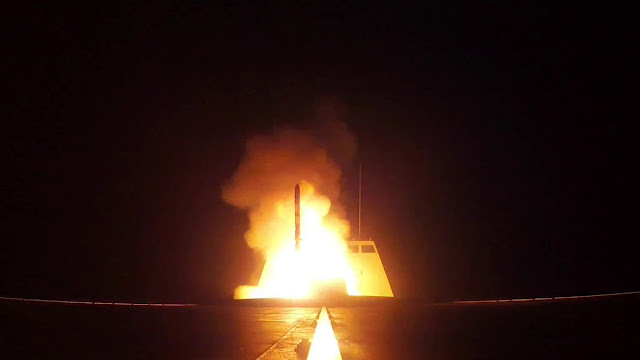
In flurry of articles surrounding last night's strikes on Syria, I noticed that a fairly important point has been largely missing from the coverage - it marked the first time France has fired naval land attack missiles in anger. Although the French naval contribution of just three missiles fired from the frigate Languedoc was rather small when compared to the dozens of Tomahawks fired from multiple American ships, it was still a major landmark for both the Marine Nationale and naval warfare as a whole. Despite the fact that the United States Navy first used land attack missiles to devastating effect during the Gulf War back in 1991, the rest of the world's navies have been remarkably slow to obtain this revolutionary capability. The Royal Navy was the second to do so, and fired land attack missiles at Kosovo in 1999. However, its capability has always been limited to a small number of submarine launched Tomahawks purchased from the United States. It was not until 2015, and ...

Float Plane Cruisers (1920-1940)

Image
The introduction of the cruiser float plane after the Great War vastly improved the scouting efficiency  of navies. So let's take a closer look at this rather underappreciated naval development. While the aircraft are an interesting subject themselves, the cruisers that operated floatplanes have been severely neglected despite being a critical part of interwar naval strategy. Japan Despite the early experiments by the United States and the large number of seaplane tenders and early carriers commissioned by Great Britain, the first navy to put float panes on its cruisers was in fact the Japanese. The Nagara - class light cruisers (lead ship commissioned in 1922) were constructed with flying off platforms above their bow armament and one plane hangers built into their bridges. This unusual arrangement was repeated in the 1924 Sendai - class and the 1926 Furutaka - class heavy cruisers also commissioned with flying off platforms (but mounted on their aft Number 4 turrets rather than...