Posts

Showing posts with the label Arleigh Burke

But What About Logistics? USN Surface Combatant Ranges (1939-2021)
Image
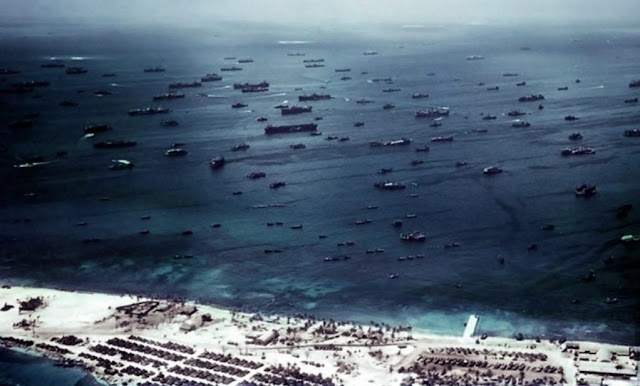
There is a cliched saying that, "Amateurs study tactics while professionals study logistics." But as there is growing interest and debate about the future of naval warfare between great powers, the influence of logistics appears to have been relegated to an afterthought. The world has not seen a full-scale naval war for almost 80 years, and technology has changed dramatically since then. In fact, technology continues changing at a breakneck pace, and numerous game-changers currently wait in the wings, ready to take their position on center stage. But as we ponder the ramifications of hypersonics, lasers, railguns, cyberwar, space-based weapons, and the whole gamut of unmanned systems, we need to remember that no amount of future weapons will eliminate the need for logistics. For the USN, logistics is a particularly critical need given America's chosen strategy of operating forward and challenging the enemy in their own backyard. However, as the number of speeches, reports...

The Future United States Navy Surface Fleet (2020-2040)

Image
With the US Navy's fiscal year 2021 budget proposal being recently released, combined with the latest news that the USN has dropped its previous plan to extended the service lives of its cruisers and destroyers to a historically unrealistic 45+ years, I thought I'd put up a quick post showing the likely future of the USN's surface fleet. Before delving deeper into the above graph, I should first make clear that the budget documents only give (somewhat) hard numbers on annual deliveries out to around FY2027, and everything past FY2031 is entirely my own projection. The assumptions I made are that CG/DDG retire after 35 years, LCS last 30 years, DDG and FFG production both stabilize at 2 ships annually, that 22 Arleigh Burke Flight III are procured to replace the Ticonderoga-class 1 for 1, and that the Future Surface Combatant phase in mirrors the planned LCS to FFG(X) transition. However, different assumptions will not change the overall shape of the future force...

FY2020 US Navy Budget Highlights

The recent United States Navy Fiscal Year 2020 budget proposal has unleashed the usual flurry of articles analyzing and discussing its ramifications. However, while the vast majority of these have focused on the same details, particularly the proposed early retirement of USS Harry Truman (CVN-75) and the introduction of large unmanned surface vessels, I will instead point out various minor pieces of information that have caught my eye. Missiles The greatest change is that antiship missiles are indeed back with a vengeance. In FY20, the Navy is proposing to procure no fewer than 216 antiship missiles of 5 different types and has stated a desire for an overall inventory of over 2000 dedicated antiship missiles. This is quite obviously aimed at the rapidly growing Chinese Navy. However, by my rough estimation, this is actually enough weapons to sink every non-US warship in the word twice over. Tomahawk Tomahawk production is restarting after a lapsing for FY19. A total of 180 weapon...

Missile Loadouts: Arleigh Burke (1991-2018)

Image
The Arleigh Burke -class guided missile destroyer was the first of a new generation of warships. Although designed and designated as destroyers, the size and capability of these ships meant that they ended up effectively filling the role previously occupied by the missile cruisers. As the years have passed, the modular nature of their combat systems has allowed them to easily accommodate new weapons and missions, until today they stand alone as the most capable multi-mission surface combatants afloat. Arleigh Burke Flight I Arleigh Burke (DDG-51) commissioned in 1991 with just three missiles: SM-2, the conventional land attack Tomahawk , and Harpoon. Although it is almost certain that she was she was designed for the nuclear and antiship versions of Tomahawk, those were withdrawn from service with the end of the Cold War and were likely never carried by any ship of the class. Further, delays with the Vertically Launched ASROC (VLA) program meant that weapon was also was not avail...

The Cost of a Warship and Some Thoughts on FFG(X) (2018)

Image
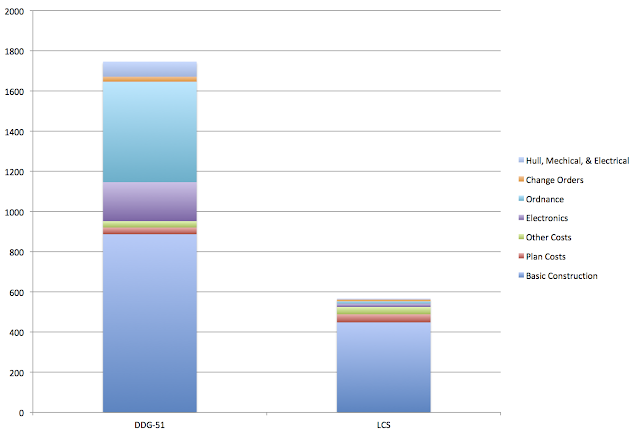
As the US Navy's FFG(X) program heats up, I've been digging through the Navy's FY19 budget submission to get an idea of various costs trade offs involved in designing a modern "medium end" warship. While none of the information that I have found is particularly revolutionary, I thought I would post my conclusions were still worth posting. Today, the Navy only has two active production lines for surface combatants - the DDG-51 Flight III  Arleigh Burke  and the LCS Flight II Freedom / Independence . However, since these two designs are on opposite ends of the spectrum (one widely acknowledged as the most capable warship in the world and the other routinely criticized for its lack of capability), comparing them directly is remarkably valuable. A DDG-51 Flight III has an official Gross Unit Cost of $1,747 million while an LCS Flight II is $565 million (all figures in this post are an average of the 7 DDG or 6 LCS in FY17-19). However, the actual amount spent p...

Modern Naval Battles: 2016 Missile Attacks in the Red Sea

Image
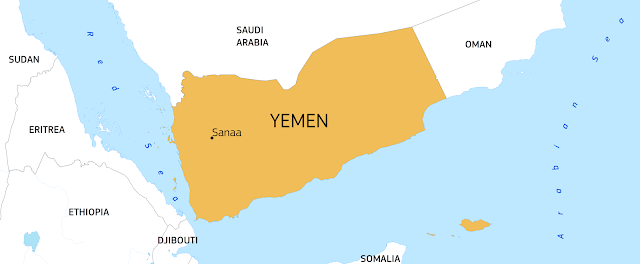
Surprising observers around the world, in October 2016, the waters off Yemen saw some of the most intense missile combat in naval history. Not only did these missile attacks highlight the extreme risk to any warship operating close to shore, they validated modern missile defense systems and demonstrated that front-line warships are capable of defending themselves from even sizeable salvos of antiship missile through a combination of hard-kill and soft-kill countermeasures. Yemen - the events described all occurred in the Red Sea off the west coast Background to the Attacks After years of steadily worsening political crises, in 2015 Yemen collapsed into full-blown civil war between government forces and the Houthi tribes of the west. Shortly after the fighting broke out in March, a Saudi-led coalition of Middle-Eastern and African nations intervened on the side of the government. This coalition was supported by the United States and made wide use of weapons (such as F-15 Eagle fi...