Posts

Showing posts with the label ESSM

Missile Loadouts: Constellation (FFG-62) (2026?)

Image
Note the "62" on this image from the Navy.mil announcement - has sanity finally returned to USN hull numbers? With the recently announced selection of the Fincantieri offering for the United States Navy's (USN) FFG(X) program, we now have enough knowledge of what the future USS Constellation will look like to post a notional missile loadout page. Now, the Constellation-class remains very much a paper design and will not join the fleet until at least 2026, so this post is even more speculative than my other missile loadouts posts . However, the result of the FFG(X) program has several unique aspects to its armament that are worth discussing. We now know that the planned armament of the Constellation-class will consist of a 32-cell Mk 41 Vertical Launch System (VLS) forward, four quad canister launchers for the RGM-184 Naval Strike Missile (NSM) amidships, and a 21-cell box launcher for RIM-116 Rolling Airframe Missile (RAM) aft. This is a considerable quantity and v...

Missile Loadouts: Japanese General Purpose Destroyers (1982-2018)

Image
During the 1970's, several new technologies such as the helicopter, the gas turbine, and the lightweight surface to air missile became available, driving the creation of a new generation of warship. The United States led the way with the Spruance -class destroyers, and the British followed with the Type 22 frigates. In Japan, these developments took somewhat longer, but eventually led to the creation of the new type of general purpose destroyer. Hatsuyuki-class The first of these new ships was the twelve members of the Hatsuyuki -class, which entered service beginning in 1982. Unlike the preceding Japanese destroyers that relied on guns, Hatsuyuki was built with a substantial missile battery for countering air, surface, and subsurface threats. This consisting of an octuplet ASROC box launcher forward, two quadruple Harpoon canister launchers amidships, and an octuplet Sea Sparrow box launcher aft (on the first ships five ships this was the American Mk 29, while the later ships we...

Missile Loadouts: Zumwalt (2019-2026)

Image
Zumwalt (DDG-1000), the lead ship of her class, before the removal of her 155mm guns The exact missile armament of the Zumwalt -class has always been a rather opaque topic and the United States Navy itself has issued a variety of contradictory statements over the years as the ships' capabilities were adjusted during construction. The mission of the Zumwalt- class has also changed substantially over the years as the ships were reworked from littoral land-attack specialists into blue water ship-killers and deep strike platforms to match the Navy's shifting strategic realities. New Weapons For A New Ship Despite the Zumwalt -class’s impressive 16,000-ton displacement, they were originally armed with just 80 vertical launch cells compared with the 90-96 of the  Arleigh Burke- class or the 122 of the  Ticonderoga -class . However, the  Zumwalt- class is equipped with the significantly larger Mk 57 VLS instead of the legacy Mk 41 VLS of the other classes, with 25-inch by 23-...

Missile Loadouts: Arleigh Burke (1991-2018)

Image
The Arleigh Burke -class guided missile destroyer was the first of a new generation of warships. Although designed and designated as destroyers, the size and capability of these ships meant that they ended up effectively filling the role previously occupied by the missile cruisers. As the years have passed, the modular nature of their combat systems has allowed them to easily accommodate new weapons and missions, until today they stand alone as the most capable multi-mission surface combatants afloat. Arleigh Burke Flight I Arleigh Burke (DDG-51) commissioned in 1991 with just three missiles: SM-2, the conventional land attack Tomahawk , and Harpoon. Although it is almost certain that she was she was designed for the nuclear and antiship versions of Tomahawk, those were withdrawn from service with the end of the Cold War and were likely never carried by any ship of the class. Further, delays with the Vertically Launched ASROC (VLA) program meant that weapon was also was not avail...

Missile Loadouts: Japanese Helicopter Destroyers (1973-2018)

Image
While aviation-heavy escort vessels were employed by several navies in the 20th century, the JMSDF stuck with them the longest. Intended to operate as the centerpiece of units that included guided missile ships and general purpose escorts, the Japanese helicopter destroyers were primarily valued for their airgroup. However, they carried a substantial armament of their own and remained fully capable of engaging enemy forces directly. The Haruna-class The two ship  Haruna -class were the first such vessels. Commissioned in 1973 and 1974, their original missile armament was an eight cell ASROC box launcher with eight reloads stored in the superstructure. While this may not seem like much, Haruna  was the first Japanese ship to carry ASROC reloads, which meant that her missile armament was actually second heaviest in the JMSDF (after its lone Tartar ship, Amatsukaze ). Haruna in 1973: 16x ASROC Beginning with Hiei in 1984 and followed by Haruna herself in 1988, these t...

2016 Yemen Missile Attacks - My Thoughts

Because of the highly speculative nature of this post, I thought it better to upload it separately from the factual description of the events. Link to the original post on the 2016 Attacks. What Missiles Did the Houthis Use? As far as I have been able to determine, the only antiship missiles present in Yemen before the civil war were the twelve C-801 missiles on the three Type 021 missile boats and the SS-N-2 Styx missiles on the Tarantul I and Osa II  missile boats. However, the Styx missile uses a corrosive liquid fuel and cannot be kept in a ready state, while the C-801 uses a far simpler solid rocket. Given the chaos in Yemen, I find it difficult to believe that Styx could remain operational. Further, C-801 weighs only a quarter as much as Styx, making it far easier transport the missiles and devise a ground launch system. The other option is that the missiles were imported after the conflict began. However, antiship missiles are large and expensive items and not the k...

Modern Naval Battles: 2016 Missile Attacks in the Red Sea

Image
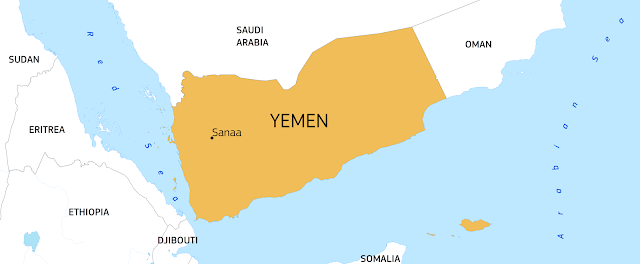
Surprising observers around the world, in October 2016, the waters off Yemen saw some of the most intense missile combat in naval history. Not only did these missile attacks highlight the extreme risk to any warship operating close to shore, they validated modern missile defense systems and demonstrated that front-line warships are capable of defending themselves from even sizeable salvos of antiship missile through a combination of hard-kill and soft-kill countermeasures. Yemen - the events described all occurred in the Red Sea off the west coast Background to the Attacks After years of steadily worsening political crises, in 2015 Yemen collapsed into full-blown civil war between government forces and the Houthi tribes of the west. Shortly after the fighting broke out in March, a Saudi-led coalition of Middle-Eastern and African nations intervened on the side of the government. This coalition was supported by the United States and made wide use of weapons (such as F-15 Eagle fi...