Posts

Showing posts with the label USSR

World Aircraft Carriers (1951 - 2020)

Image
All non-US carriers operating fixed-wing aircraft (click to enlarge) The aircraft carrier has been the ultimate expression of naval power since World War II. Able to engage air, surface, and subsurface targets from hundreds of miles away, the carrier is a highly versatile class of warship and even a small number of carriers can turn the tide of an entire war. However, these ships (and the aircraft that they carry) are extremely expensive and only a handful of navies have ever operated them. Since the end of World War II, only 14 nations have operated a carrier with fixed-wing aircraft and no more than 9 nations have done so simultaneously. The above chart covers all non-US aircraft carriers operating fixed-wing aircraft from 1951-2020. I have not only excluded helicopter carriers, but also attempted to avoid counting commissioned ships that did not have available aircraft (for instance, I did not count the Soviet Kiev-class ships after 1991, when their Yak-38 fighters were phased out)...
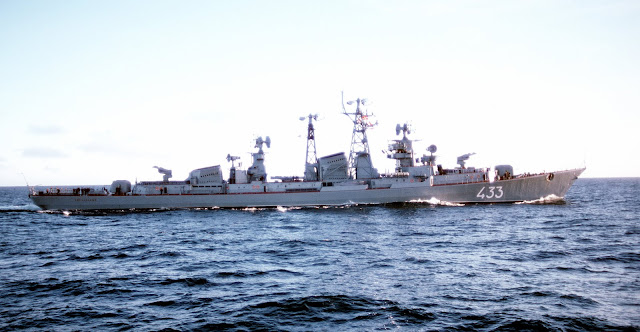
Missile Loadouts: Project 61 "Kashin" (1962-2020)

Image
After the end of World War II, it was discovered that the pre-war types of naval ships were largely obsolete and did not reflect the new reality of warfare. Experiments eventually led to a new breed of large multirole missile ships in the 1950’s. Among United States and her allies these ships were known as “frigates” or “DLG’s,” but in the Soviet Union they were dubbed “large antisubmarine ships” (большие противолодочные корабли). The first of these large antisubmarine ships was Project 61, known to NATO as the Kashin -class cruisers. However, the early members of this class were actually commissioned as “patrol ships” (сторожевых корабли) before their classification was changed in 1966. Commissioned between 1962 and 1970, the 20 ships of Project 61 were contemporaries of the 20 American frigates of the Leahy , Bainbridge , Belknap , and Truxtun classes . Measuring 144 meters in length, Project 61 was significantly smaller than the 162 or 172 meters of the American ships. However...

Missile Threat - USSR vs China (1988 & 2018)

Image
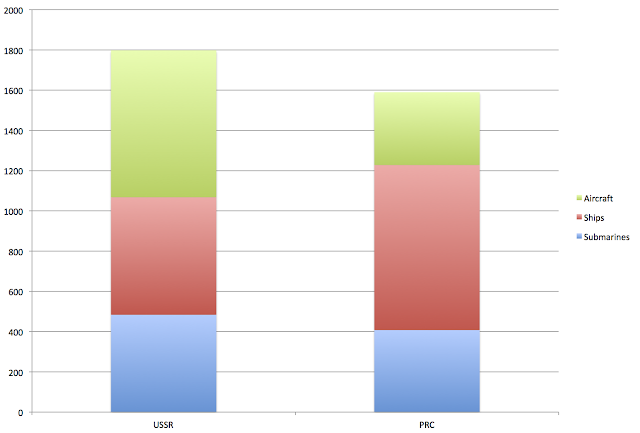
One of the best uses of history is to gain perspective on the present. Today, there is much talk in naval circles about A2/AD environments and the antiship missile threat in a potential war with China. However, there is surprisingly little reference to the very similar threat the Soviet Navy posed not so long ago. This comparison is particularly apt as the maritime strategies of the USSR of 1988 and the PRC of 2018 have much in common. Both were primarily land powers that had developed a defensive navy with significant blue water reach. In 1988, the Soviet Navy fielded a force of 64 submarines, 85 surface ships, and roughly 365 bombers equipped with some 1798 antiship missiles. In comparison, the Chinese Navy of 2018 has 48 submarines, 112 surface ships, and roughly 180 bombers and fighters that carry around 1590 missiles. While both navies also fielded missile craft and shore launchers, platforms of this nature cannot seriously contesting sea control and will be excluded from this...

Float Plane Cruisers (1920-1940)

Image
The introduction of the cruiser float plane after the Great War vastly improved the scouting efficiency  of navies. So let's take a closer look at this rather underappreciated naval development. While the aircraft are an interesting subject themselves, the cruisers that operated floatplanes have been severely neglected despite being a critical part of interwar naval strategy. Japan Despite the early experiments by the United States and the large number of seaplane tenders and early carriers commissioned by Great Britain, the first navy to put float panes on its cruisers was in fact the Japanese. The Nagara - class light cruisers (lead ship commissioned in 1922) were constructed with flying off platforms above their bow armament and one plane hangers built into their bridges. This unusual arrangement was repeated in the 1924 Sendai - class and the 1926 Furutaka - class heavy cruisers also commissioned with flying off platforms (but mounted on their aft Number 4 turrets rather than...

Battleships and Gun Cruisers of the Major Cold War Navies

Image
Cannon were first used at sea sometime in the 15th century. While various siege engines had been employed by navies for thousands of years, they never had a profound effect on war at sea. Instead, naval combat was dominated by ramming and boarding actions. While these ancient tactics remain in use today, guns fundamentally transformed naval warfare as they allowed a ship to disable or even sink its enemies from a distance. Guns developed over time from the small manually aimed muzzle loaders of the early days to the massive computer controlled weapons of the World Wars. Range, rate of fire, throw weight, and accuracy all made tremendous strides but the basic principals remained the same for the five centuries when guns dominated naval combat. The 19th century saw this dominance shaken by the introduction of various forms of mines and torpedoes, but it was not until the introduction of aircraft in the 20th century that the gun was finally replaced as the primary naval weapon. Althou...

Soviet Naval Antiship Missiles of the Cold War: 1957-1991

Image
An SS-N-22 Sunburn supersonic antiship missile The antiship missile was pioneered by the United States and Germany. Both nations tested experimental weapons during World War I and then deployed operational weapons during World War II. However, all of these were air launched missiles. While the United States Navy made major advances in ship and submarine launched weapons in the post war period, it did not field any antiship weapons on these platforms - probably because of both a lack of suitable targets and satisfaction with its existing antiship weapons.  In contrast, when World War II ended the Soviet Navy was in desperate need of powerful antiship weapons. Its small force of torpedo boats, destroyers, and light cruisers now faced an overwhelmingly powerful American Navy whose carriers and cruisers were armed with nuclear weapons for use against targets far inland. While the Soviet Union developed and deployed large numbers of air launched antiship missiles, it also pio...