Posts

Showing posts with the label Russia

The Loss of Moskva and Lessons for the Future
Image
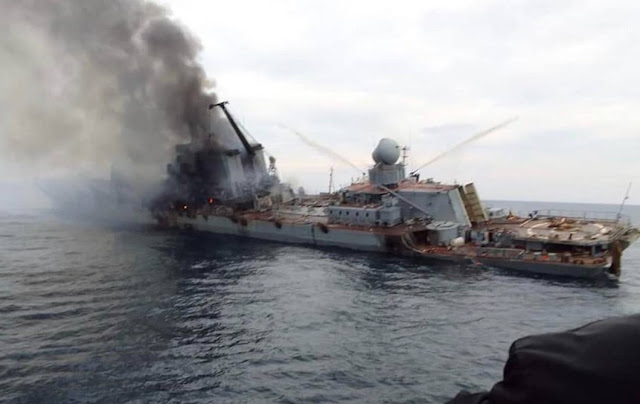
Moskva listing and on fire before she sank Late on April 14, 2022, the Russian cruiser Moskva sank while under tow, making her the largest warship lost in wartime since the sinking of the Argentinian cruiser General Belgrano during the Falklands War almost exactly 40 years before. While the details of the sinking are unlikely to be cleared up anytime soon, and the war in Ukraine remains far too confused for us to draw any tactical conclusions, the event is far too significant for us to ignore entirely, and perhaps there are some relevant lessons to be found. What Do We Know About the Loss of Moskva? To begin with, we must examine what we know about the loss of Moskva , which is, unfortunately, very little. On April 13, the Russians announced that Moskva had suffered an explosion and that her crew had been evacuated. On the same day, the Ukrainians announced that they had attacked her with Neptune anti-ship missiles. While it is probable that Moskva was indeed damaged through enemy act...

World Navies of 2021

Image
HMS Spey , the latest addition to the Royal Navy. While often underappreciated, offeshore patrol vessels like her are critical to projecting naval power at home and around the world. World Navies in the New Year For a much-delayed first post of the new year, we have the official Influence of History  2021 World Navy Rankings. As always, this ranking system attempts to provide an overview of the relative naval power of the world's nations by listing their naval inventories and providing a somewhat relative points value. Because of the contentious nature of warship classification, I have resorted to my own fairly simplistic, but universal, system that classifies ships based on size and type. Points are determined based on the number and type of ships. While my system does attempt to capture total national naval power by including coast guard ships and other government vessels, it does not count coastal craft outside of missile boats and minesweepers. The points system has remained fa...

World Aircraft Carriers (1951 - 2020)

Image
All non-US carriers operating fixed-wing aircraft (click to enlarge) The aircraft carrier has been the ultimate expression of naval power since World War II. Able to engage air, surface, and subsurface targets from hundreds of miles away, the carrier is a highly versatile class of warship and even a small number of carriers can turn the tide of an entire war. However, these ships (and the aircraft that they carry) are extremely expensive and only a handful of navies have ever operated them. Since the end of World War II, only 14 nations have operated a carrier with fixed-wing aircraft and no more than 9 nations have done so simultaneously. The above chart covers all non-US aircraft carriers operating fixed-wing aircraft from 1951-2020. I have not only excluded helicopter carriers, but also attempted to avoid counting commissioned ships that did not have available aircraft (for instance, I did not count the Soviet Kiev-class ships after 1991, when their Yak-38 fighters were phased out)...

World Carrier Air Wings (2019): Part 1

Image
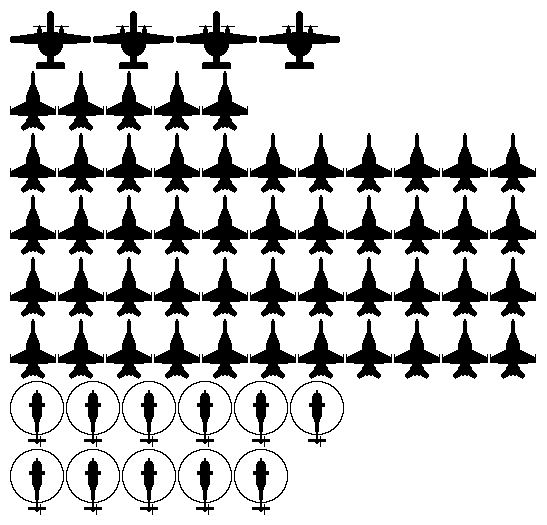
This post will cover the composition of the air wings of the world's current major aircraft carriers. This includes the American Nimitz -class, the French Charles de Gaulle , the Chinese Liaoning , the Indian Vikramaditya , and the Russian Kuznetsov . The air wings of the smaller VSTOL are covered in Part 2 . Nimitz-class The uncontested apex of carrier air wings is found aboard the United State’s 10 Nimitz -class carriers (the Gerald Ford -class will carry the same air wing, although the lead ship is not yet operational). These ships generally operate 64 aircraft, twice as many as their competitors. Further, unlike almost all non-American carriers, the Nimitz-class is equipped for catapult takeoff and arrested recovery (CATOBAR), permitting the operation of heavy aircraft with full loads of weapons and fuel. 2019 Nimitz-class air wing: 4x E-2D, 5x EA-18G, 44x F/A-18E/F, 11x MH-60R/S Arguably the most important aircraft in this air wing are its 4 the E-2 Hawkeye 29-ton fi...

Average Warship Age (2018)

Image
This began as a quick look at the average age of the warships of the Russian navy, but the results were interesting so I expanded it to include the top dozen navies. For simplicity's sake, I only considered the following vessels: carriers (including flattop amphibious ships), submarines (excluding ballistic missile submarines), and surface combatants of over 100 meters in length (excluding coast guard and training ships). In the national breakdowns I further separate surface combatants into "large" and "small," with the former being ships of at least 150 meters in length. Given that warships are generally built with an intended service life of around thirty years, we can predict that a healthy fleet should have an average service life of around fifteen years. A figure noticeably higher than that reveals that the fleet is unable to replace aging ships, while a significantly lower number indicates that the fleet is undergoing rapid expansion. However, this on...