Posts

Showing posts with the label Missiles

SM-2 and the Danish Navy: The Devil is in the Details (2005-2022)

Image
SM-2 missiles being loaded aboard the Danish frigate Niels Juel for the first time - note the second missile cannister in the foreground In the days of battleships, understanding the firepower of a warship was simple - all you needed to do was count up the size and number of guns it was armed with, and you had a decent idea of what it was capable of contributing to a battle. These days, things are more complicated. Especially with the development of the universal VLS that can handle a variety of different missiles. All too often, modern warships are capable of carrying missiles that they have never actually been equipped with, leading casual observers to profoundly misunderstand the ships' combat capabilities. A recent, and particularly egregious, example of this phenomenon concerns the Danish Iver Huitfeldt-class fregatter (frigates). A quick check of the ships' Wikipedia page will reveal that they are supposedly armed with: Armament of the Iver Huitfeldt-class (according to ...

FY2020 US Navy Budget Highlights

The recent United States Navy Fiscal Year 2020 budget proposal has unleashed the usual flurry of articles analyzing and discussing its ramifications. However, while the vast majority of these have focused on the same details, particularly the proposed early retirement of USS Harry Truman (CVN-75) and the introduction of large unmanned surface vessels, I will instead point out various minor pieces of information that have caught my eye. Missiles The greatest change is that antiship missiles are indeed back with a vengeance. In FY20, the Navy is proposing to procure no fewer than 216 antiship missiles of 5 different types and has stated a desire for an overall inventory of over 2000 dedicated antiship missiles. This is quite obviously aimed at the rapidly growing Chinese Navy. However, by my rough estimation, this is actually enough weapons to sink every non-US warship in the word twice over. Tomahawk Tomahawk production is restarting after a lapsing for FY19. A total of 180 weapon...

Navy Assault Drones (1936-1944)

Image
The last surviving TDR-1 assault drone at the Naval Aviation Museum in Pensacola, FL. The United States Navy has always had a rather mixed history with antiship missiles. While its failure to widely field such weapons except for a brief period at the end of the Cold War has given it a reputation for being backwards in the area, in fact it was the very first to begin serious work on them. Although overshadowed in history by the German HS-293 and Fritz-X glide bombs, the United States actually fielded far more advanced weapons during the war in the form of the ASM-N-2 Bat and TDR Assault Drone. It is the latter of these two missiles that will be the subject of this post. The genesis of the assault drone program came in July 1936, when the Navy began research into a remote controlled aerial target for more realistic antiaircraft gunnery practice (at this point it was limited to towed targets that could not simulate torpedo or dive bombing attacks). This program (later named Project...

France Joins the Club

Image
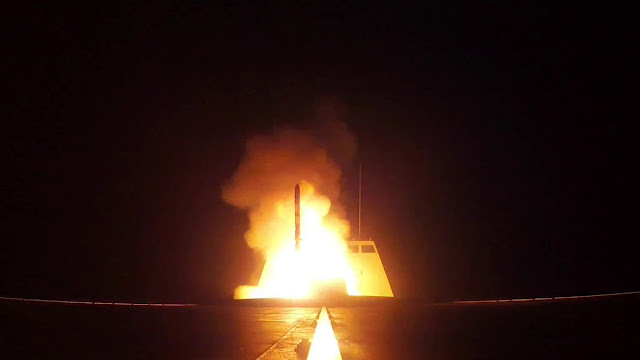
In flurry of articles surrounding last night's strikes on Syria, I noticed that a fairly important point has been largely missing from the coverage - it marked the first time France has fired naval land attack missiles in anger. Although the French naval contribution of just three missiles fired from the frigate Languedoc was rather small when compared to the dozens of Tomahawks fired from multiple American ships, it was still a major landmark for both the Marine Nationale and naval warfare as a whole. Despite the fact that the United States Navy first used land attack missiles to devastating effect during the Gulf War back in 1991, the rest of the world's navies have been remarkably slow to obtain this revolutionary capability. The Royal Navy was the second to do so, and fired land attack missiles at Kosovo in 1999. However, its capability has always been limited to a small number of submarine launched Tomahawks purchased from the United States. It was not until 2015, and ...

2016 Yemen Missile Attacks - My Thoughts

Because of the highly speculative nature of this post, I thought it better to upload it separately from the factual description of the events. Link to the original post on the 2016 Attacks. What Missiles Did the Houthis Use? As far as I have been able to determine, the only antiship missiles present in Yemen before the civil war were the twelve C-801 missiles on the three Type 021 missile boats and the SS-N-2 Styx missiles on the Tarantul I and Osa II  missile boats. However, the Styx missile uses a corrosive liquid fuel and cannot be kept in a ready state, while the C-801 uses a far simpler solid rocket. Given the chaos in Yemen, I find it difficult to believe that Styx could remain operational. Further, C-801 weighs only a quarter as much as Styx, making it far easier transport the missiles and devise a ground launch system. The other option is that the missiles were imported after the conflict began. However, antiship missiles are large and expensive items and not the k...

Missile Loadouts: US Cruiser Conversions (1955-1980)

Image
The United States Navy's first four classes of guided missile cruisers were conversions of WWII-era gun cruisers of the Baltimore , Cleveland , and Oregon City -classes and were armed with the first-generation Terrier, Talos, and Tartar missiles . While short lived and and ultimately a dead end in warship design, these vessels were revolutionary when commissioned. Boston-class The two ships of the  Boston -class were converted from Baltimore -class heavy cruisers to become the world's first operational guided missile warships. They retained much of their original gun armament, losing only their rearmost 8" and 5" turrets. These two turrets were replaced with a pair of twin rail Mk 4 launchers with magazines for a staggering one-hundred and forty-four Terrier missiles. Boston in 1955: 144x Terrier Galveston-class and Providence-class The next round of cruiser conversions switched to the smaller but more numerous Cleveland -class light cruisers. Six ships were con...

The US Guided Missile Force (1955-2017)

Image
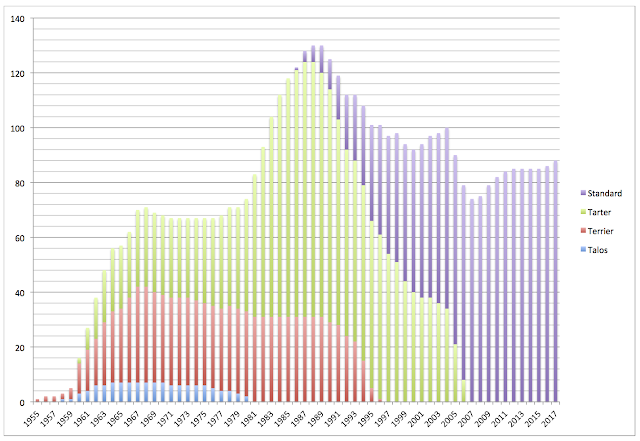
After having examined the incredible effectiveness of even an early guided missile ship in surface warfare  a few days ago, I became interested in creating a chart of the growth of the US Navy's guided missile force to compare with the decline of the US Navy's battleship and gun cruiser fleet that I made last month. The USN Guided Missile Fleet Before comparing the two, let's look at the missile chart as it has some interesting information. For some additional detail I broke the ships down by launcher - the Terrier and Tartar categories also include Standard ER and Standard MR, respectively, while the Standard category only covers VLS ships (which, it should be remembered, didn't have an ER missile until 1999). Unfortunately, I don't have good information on the exact dates the Perry's lost their Mk 13 launchers so the final 3 years of Tarter are merely a best guess based on available information. Chart of all commissioned US Navy guided missile ships (195...

Surface to Air Missiles... As Antiship Weapons

Image
While the United States Navy has never fully embraced the concept of the dedicated antiship missile, adopting and then abandoning a number of systems, that does not mean that its missile ships have even been defenseless against surface attack. In fact, even its earliest converted missile cruisers possessed greater antiship firepower than a World War II battleship. Surface to Air Missiles in Surface to Surface Mode The secret behind this is the use of surface to air missiles in surface to surface mode. Until the introduction of the infrared homing Rolling Airframe Missile in the early 1990's, all of the Navy's surface launched antiaircraft missiles have been semiactive radar homing. This means that as long as the ship mounted illumination radars can get a clear reflection off the target, the target can be engaged - even if it's a ship instead of an airplane (while this means that ships cannot be engaged from over the horizon, there has never actually been a successful over...

Missile Loadouts: Ticonderoga-class (1983-2018)

Image
Over their thirty years in service, the missile armament of the Ticonderoga -class cruisers has experienced dramatic evolution and by the time the last one finally decommissions, it is quite possible that not one of the design's original missiles or launchers will remain. The Original Armament When USS Ticonderoga (CG-47)   commissioned in 1983, she was armed with two Mk 26 twin-arm launchers, each fed from a forty-four round magazine containing both SM-2MR surface-to-air-missiles and ASROC antisubmarine weapons (both nuclear and conventional variants). Finally, as with most USN ships of her generation, Ticonderoga  also carried eight Harpoon antiship missiles in Mk 141 canister launchers on the fantail. Ticonderoga in 1983: 72x SM-2MR, 16x ASROC, 8x Harpoon The Mk 41 VLS Is Introduced In 1986, this armament changed drastically when USS Bunker Hill (CG-52) commissioned with two sixty-one cell Mk 41 Vertical Launch Systems instead of Mk 26 launchers. This had the o...

Soviet Naval Antiship Missiles of the Cold War: 1957-1991

Image
An SS-N-22 Sunburn supersonic antiship missile The antiship missile was pioneered by the United States and Germany. Both nations tested experimental weapons during World War I and then deployed operational weapons during World War II. However, all of these were air launched missiles. While the United States Navy made major advances in ship and submarine launched weapons in the post war period, it did not field any antiship weapons on these platforms - probably because of both a lack of suitable targets and satisfaction with its existing antiship weapons.  In contrast, when World War II ended the Soviet Navy was in desperate need of powerful antiship weapons. Its small force of torpedo boats, destroyers, and light cruisers now faced an overwhelmingly powerful American Navy whose carriers and cruisers were armed with nuclear weapons for use against targets far inland. While the Soviet Union developed and deployed large numbers of air launched antiship missiles, it also pio...