Posts

Showing posts with the label Terrier

Missile Loadouts: USN Missile Cruisers (1959-1999)

Image
After the initial introduction of guided missile systems on converted gun cruisers, it became clear that a new type of warship was needed as the existing designs were either too small or unnecessarily large. These new ships were assigned the hull designation DLG and dubbed “frigates” after the famous sailing ships such as USS Constitution. That the USN applied this name to powerful guided missile ships while the European navies used it to refer to cheap submarine hunters reflects a historic difference - in the nineteenth century, the frigates were the most powerful vessels in the small American navy, while in Europe the frigates were seen as minor combatants that lived in the shadow of the ships of the line. However, the American use of this term did not survive long, and, in 1975, the USN dropped the DLG designation as part of a wider simplification of its hull numbers. The frigates were redesignated as either cruisers (CG) or destroyers (DDG). Simultaneously, the ocean escorts (DE)...

Standard Missile 2 Midcourse Guidance

Image
The RIM-66 SM-2MR in its boost phase One of the less appreciated aspects of naval warfare is how the same weapon can have rather different capabilities depending on the combat system controlling it. The neglect of this point is somewhat remarkable given that the importance of combat systems was made obvious well over a hundred years ago with the introduction of centralized fire control. But this post is about the RIM-66/RIM-67/RIM-156 SM-2 - the mainstay of Western naval air defense. This missile has been integrated with a variety of combat systems including Aegis, Terrier, and Tartar, as well as several foreign systems, but it actually functions in rather different ways depending on which system is controlling it. As is widely known, SM-2 represented a massive advance over its predecessor (SM-1) because of its use of a programmable autopilot. This allowed SM-2 to fly a more efficient ballistic trajectory, almost doubling its range, as well as time share illuminators, allowing a...

Missile Loadouts: USS Long Beach (1961-1995)

Image
USS Long Beach (CGN-9) was a truly one of a kind ship and not solely because she was the only ship of her class. Long Beach  holds many records including being the world's first purpose-built guided missile warship, the first nuclear-powered surface vessel, and the first ship to use missiles to shoot down an airplane in combat (she scored two MiG kills in Vietnam). She also has the dubious distinction of being the only US Navy surface combatant to be built without any guns (although two 5" mounts were later added). Finally, Long Beach was America's last cruiser, with all succeeding cruiser classes being originally designed as either frigates or destroyers and subsequently redesignated. The Original Armament Long Beach originally commissioned with a mixed battery of one twin Talos launcher (52 missiles), two twin Terrier launchers (one with 40 missiles and one with 80), and an eight-cell ASROC box launcher with twelve reloads. This gave her an impressive armament of 192 m...

Missile Loadouts: US Cruiser Conversions (1955-1980)

Image
The United States Navy's first four classes of guided missile cruisers were conversions of WWII-era gun cruisers of the Baltimore , Cleveland , and Oregon City -classes and were armed with the first-generation Terrier, Talos, and Tartar missiles . While short lived and and ultimately a dead end in warship design, these vessels were revolutionary when commissioned. Boston-class The two ships of the  Boston -class were converted from Baltimore -class heavy cruisers to become the world's first operational guided missile warships. They retained much of their original gun armament, losing only their rearmost 8" and 5" turrets. These two turrets were replaced with a pair of twin rail Mk 4 launchers with magazines for a staggering one-hundred and forty-four Terrier missiles. Boston in 1955: 144x Terrier Galveston-class and Providence-class The next round of cruiser conversions switched to the smaller but more numerous Cleveland -class light cruisers. Six ships were con...

The US Guided Missile Force (1955-2017)

Image
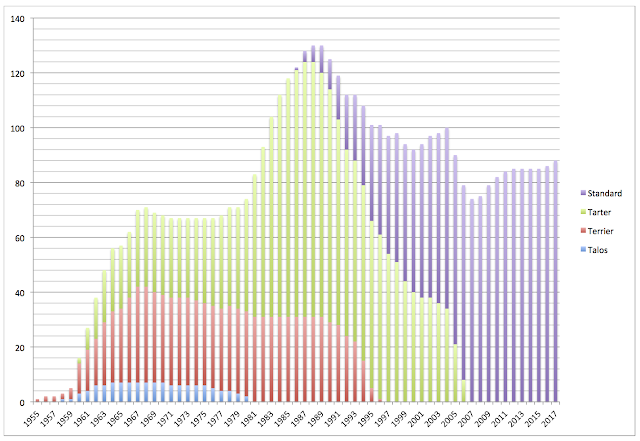
After having examined the incredible effectiveness of even an early guided missile ship in surface warfare  a few days ago, I became interested in creating a chart of the growth of the US Navy's guided missile force to compare with the decline of the US Navy's battleship and gun cruiser fleet that I made last month. The USN Guided Missile Fleet Before comparing the two, let's look at the missile chart as it has some interesting information. For some additional detail I broke the ships down by launcher - the Terrier and Tartar categories also include Standard ER and Standard MR, respectively, while the Standard category only covers VLS ships (which, it should be remembered, didn't have an ER missile until 1999). Unfortunately, I don't have good information on the exact dates the Perry's lost their Mk 13 launchers so the final 3 years of Tarter are merely a best guess based on available information. Chart of all commissioned US Navy guided missile ships (195...

Surface to Air Missiles... As Antiship Weapons

Image
While the United States Navy has never fully embraced the concept of the dedicated antiship missile, adopting and then abandoning a number of systems, that does not mean that its missile ships have even been defenseless against surface attack. In fact, even its earliest converted missile cruisers possessed greater antiship firepower than a World War II battleship. Surface to Air Missiles in Surface to Surface Mode The secret behind this is the use of surface to air missiles in surface to surface mode. Until the introduction of the infrared homing Rolling Airframe Missile in the early 1990's, all of the Navy's surface launched antiaircraft missiles have been semiactive radar homing. This means that as long as the ship mounted illumination radars can get a clear reflection off the target, the target can be engaged - even if it's a ship instead of an airplane (while this means that ships cannot be engaged from over the horizon, there has never actually been a successful over...

Bumblebee, Lark, and Little Joe: US Navy Guided Missiles 1944-1955

Image
RIM-8 Talos Today guided missiles are an integral part of the United States Navy and warships armed with the Aegis combat system are considered the pinnacle of surface combatant development. However, unlike most new weapons systems, the naval guided missile was not the result of incremental advances over time. Instead, it was the result a decade long project designed to create the theoretical weapon that was deemed necessary to counter an emerging threat. The First Naval Missiles While rockets have been a part of warfare for centuries (British ship-launched Congreve rockets are immortalized in the American national anthem), they had always been inaccurate ballistic devices that were clearly inferior to guns. This changed with the introduction of aircraft and the development of radio at the end of the 19th century. Suddenly it became possible to construct a missile (not necessarily a rocket) that could not only change course in flight, but receive targeting information and cour...