Posts

Showing posts with the label Missile Loadouts

Missile Loadouts: Project 61 "Kashin" (1962-2020)
Image
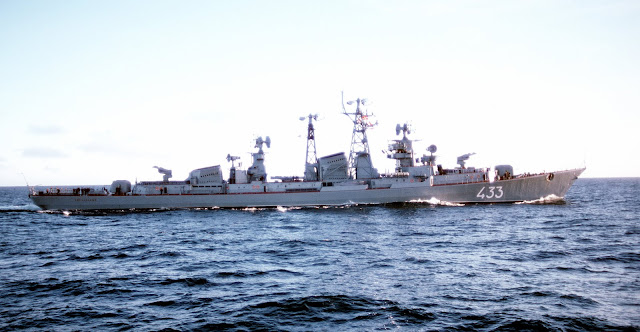
After the end of World War II, it was discovered that the pre-war types of naval ships were largely obsolete and did not reflect the new reality of warfare. Experiments eventually led to a new breed of large multirole missile ships in the 1950’s. Among United States and her allies these ships were known as “frigates” or “DLG’s,” but in the Soviet Union they were dubbed “large antisubmarine ships” (большие противолодочные корабли). The first of these large antisubmarine ships was Project 61, known to NATO as the Kashin -class cruisers. However, the early members of this class were actually commissioned as “patrol ships” (сторожевых корабли) before their classification was changed in 1966. Commissioned between 1962 and 1970, the 20 ships of Project 61 were contemporaries of the 20 American frigates of the Leahy , Bainbridge , Belknap , and Truxtun classes . Measuring 144 meters in length, Project 61 was significantly smaller than the 162 or 172 meters of the American ships. However...

Missile Loadouts: Constellation (FFG-62) (2026?)

Image
Note the "62" on this image from the Navy.mil announcement - has sanity finally returned to USN hull numbers? With the recently announced selection of the Fincantieri offering for the United States Navy's (USN) FFG(X) program, we now have enough knowledge of what the future USS Constellation will look like to post a notional missile loadout page. Now, the Constellation-class remains very much a paper design and will not join the fleet until at least 2026, so this post is even more speculative than my other missile loadouts posts . However, the result of the FFG(X) program has several unique aspects to its armament that are worth discussing. We now know that the planned armament of the Constellation-class will consist of a 32-cell Mk 41 Vertical Launch System (VLS) forward, four quad canister launchers for the RGM-184 Naval Strike Missile (NSM) amidships, and a 21-cell box launcher for RIM-116 Rolling Airframe Missile (RAM) aft. This is a considerable quantity and v...

Missile Loadouts: British Air Warfare Ships (1962-2026)

Image
The County-class Unlike most navies, the Royal Navy's first guided missile ships were not conversions of existing ships. Instead, they were the eight purpose-built  County -class destroyers, which entered service beginning in 1962. Measuring 158 meters in length, these ships were much larger than the proceeding 120-meter Daring -class gun destroyers and were commonly referred to as "DLG" after the American hull code for large missile ships like the contemporary Farragut -class frigates . Further, rather than relying on American missiles as was done by most NATO navies, the British chose to build the County -class around the domestic Sea Slug surface-to-air missile - a weapon that unfortunately lived up to its underwhelming name. A beam riding missile with a range of 25 kilometers and a top speed of Mach 1.5 (many sources state Sea Slug was subsonic, this is incorrect and likely a misreading of the fact that it could only engage subsonic targets), Sea Slug was comparable...

Missile Loadouts: Spruance-class Destroyers (1975-2005)

Image
The Spruance -class destroyers have probably the most complex missile loadout history of any non-air defense ship. Unfortunately, the numerous changes and variation have surprisingly little available documentation and I have been forced to rely heavily on photographs to fill in the gaps. Therefore, many of the dates in this post are only estimates. The Spruance -class was designed during the late 1960’s as a modern warship to replace the large number of WWII-era Fletcher , Allen M Sumner , and Gearing -class class destroyers that were swiftly becoming obsolete. Force structure analysis during the design process revealed that while air defense systems significantly increased unit cost, it was ASW that drove force size requirements. Therefore, it was decided to supplement DDG and DLG production with a more affordable DD design that eventually became the Spruance -class. In a drive for greater efficiency, the DD would also share its hull with a DDG design. While the related DDG was neve...

Missile Loadouts: Chinese 052-series Destroyers (1994-2019)

Image
The 052-series destroyers have represented the cutting edge of Chinese naval technology in the post-Cold War period. The original Type 052 destroyer joined the fleet in 1994 and, although its capabilities were limited, it is considered China’s first modern warship. The basic design proved solid and went through several variations, each dramatically improving its combat systems and missile armament. In its latest iteration as the Type 052D, it forms the backbone of the Chinese surface fleet and will continue to do so for the foreseeable future. Type 052 The original Type 052 was a basic 155 meter multipurpose destroyer with an emphasis on antisurface warfare. The two members of the class incorporated many foreign technologies and were more experimental platforms than serious warships. The offensive missile battery consisted of an impressive 16 YJ-83 antiship missiles in canister launchers amidship. With a range of 200 kilometers and a 420-pound warhead, these missiles gave the Type 05...

Missile Loadouts: Japanese General Purpose Destroyers (1982-2018)

Image
During the 1970's, several new technologies such as the helicopter, the gas turbine, and the lightweight surface to air missile became available, driving the creation of a new generation of warship. The United States led the way with the Spruance -class destroyers, and the British followed with the Type 22 frigates. In Japan, these developments took somewhat longer, but eventually led to the creation of the new type of general purpose destroyer. Hatsuyuki-class The first of these new ships was the twelve members of the Hatsuyuki -class, which entered service beginning in 1982. Unlike the preceding Japanese destroyers that relied on guns, Hatsuyuki was built with a substantial missile battery for countering air, surface, and subsurface threats. This consisting of an octuplet ASROC box launcher forward, two quadruple Harpoon canister launchers amidships, and an octuplet Sea Sparrow box launcher aft (on the first ships five ships this was the American Mk 29, while the later ships we...

Missile Loadouts: Zumwalt (2019-2026)

Image
Zumwalt (DDG-1000), the lead ship of her class, before the removal of her 155mm guns The exact missile armament of the Zumwalt -class has always been a rather opaque topic and the United States Navy itself has issued a variety of contradictory statements over the years as the ships' capabilities were adjusted during construction. The mission of the Zumwalt- class has also changed substantially over the years as the ships were reworked from littoral land-attack specialists into blue water ship-killers and deep strike platforms to match the Navy's shifting strategic realities. New Weapons For A New Ship Despite the Zumwalt -class’s impressive 16,000-ton displacement, they were originally armed with just 80 vertical launch cells compared with the 90-96 of the  Arleigh Burke- class or the 122 of the  Ticonderoga -class . However, the  Zumwalt- class is equipped with the significantly larger Mk 57 VLS instead of the legacy Mk 41 VLS of the other classes, with 25-inch by 23-...

Missile Loadouts: French Air Warfare Ships (1962-2018)

Image
The Marine Nationale has a somewhat mixed history with guided missile ships. It obtained its first such ship back to 1962, the same year as the Royal Navy. Further, France has domestically designed and produced two generations of naval surface to air missiles. However, every class of French guided missile ships was cut short for budgetary reasons, resulting in a perpetually undersized fleet, and none of these ships has every fired a missile in anger, leaving their actual combat effectiveness open to question. Surcouf-class The first French guided missile ships were conversions of the  Surcouf -class escorteurs d'escadre. Originally armed with a heavy battery of six 5" and six 57mm guns, the twelve ships of the Surcouf -class were the first French destroyers built after WWII and entered service 1955-1957. While France already had an indigenous naval missile program, the United States offered to supply a number of Tartar missile systems free of charge. Four ships were selected ...