Posts

Showing posts with the label China

World Navies of 2021

Image
HMS Spey , the latest addition to the Royal Navy. While often underappreciated, offeshore patrol vessels like her are critical to projecting naval power at home and around the world. World Navies in the New Year For a much-delayed first post of the new year, we have the official Influence of History  2021 World Navy Rankings. As always, this ranking system attempts to provide an overview of the relative naval power of the world's nations by listing their naval inventories and providing a somewhat relative points value. Because of the contentious nature of warship classification, I have resorted to my own fairly simplistic, but universal, system that classifies ships based on size and type. Points are determined based on the number and type of ships. While my system does attempt to capture total national naval power by including coast guard ships and other government vessels, it does not count coastal craft outside of missile boats and minesweepers. The points system has remained fa...

World Aircraft Carriers (1951 - 2020)

Image
All non-US carriers operating fixed-wing aircraft (click to enlarge) The aircraft carrier has been the ultimate expression of naval power since World War II. Able to engage air, surface, and subsurface targets from hundreds of miles away, the carrier is a highly versatile class of warship and even a small number of carriers can turn the tide of an entire war. However, these ships (and the aircraft that they carry) are extremely expensive and only a handful of navies have ever operated them. Since the end of World War II, only 14 nations have operated a carrier with fixed-wing aircraft and no more than 9 nations have done so simultaneously. The above chart covers all non-US aircraft carriers operating fixed-wing aircraft from 1951-2020. I have not only excluded helicopter carriers, but also attempted to avoid counting commissioned ships that did not have available aircraft (for instance, I did not count the Soviet Kiev-class ships after 1991, when their Yak-38 fighters were phased out)...

The Slow Growth of the Chinese Navy (1990-2019)

Image
Since the end of the Cold War, the Chinese Navy has grown from an obsolete coast defense force into the second largest navy in the world. Now composed of every class of modern warship, including aircraft carriers, nuclear submarines, and guided missile destroyers, as well as the necessary auxiliaries needed to support them, the Chinese Navy has become a true blue water force seemingly overnight. However, a closer examination reveals that the growth of the Chinese Navy has actually been rather measured and may well be aiming for a smaller overall force than many estimate. For the purposes of this post, I'm only going to be covering the larger Chinese surface combatants because accurate numbers on their small combatants, submarines, and auxiliaries are simply not available. However, this may actually overestimate the Chinese expansion because the growth of their auxiliary and submarine fleets in particular have lagged behind that of their surface force. Naval Growth Lags Econ...

World Carrier Air Wings (2019): Part 1

Image
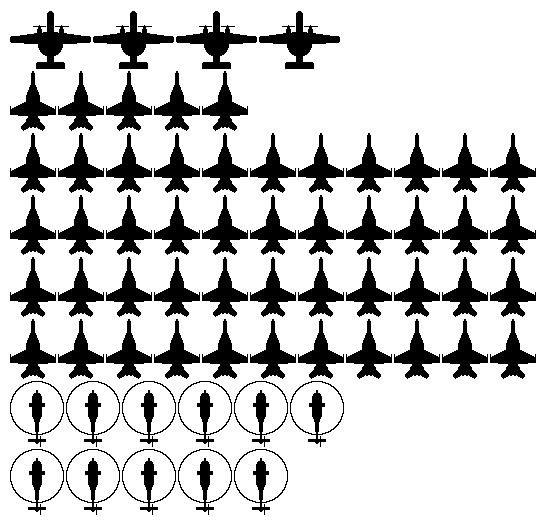
This post will cover the composition of the air wings of the world's current major aircraft carriers. This includes the American Nimitz -class, the French Charles de Gaulle , the Chinese Liaoning , the Indian Vikramaditya , and the Russian Kuznetsov . The air wings of the smaller VSTOL are covered in Part 2 . Nimitz-class The uncontested apex of carrier air wings is found aboard the United State’s 10 Nimitz -class carriers (the Gerald Ford -class will carry the same air wing, although the lead ship is not yet operational). These ships generally operate 64 aircraft, twice as many as their competitors. Further, unlike almost all non-American carriers, the Nimitz-class is equipped for catapult takeoff and arrested recovery (CATOBAR), permitting the operation of heavy aircraft with full loads of weapons and fuel. 2019 Nimitz-class air wing: 4x E-2D, 5x EA-18G, 44x F/A-18E/F, 11x MH-60R/S Arguably the most important aircraft in this air wing are its 4 the E-2 Hawkeye 29-ton fi...

Missile Loadouts: Chinese 052-series Destroyers (1994-2019)

Image
The 052-series destroyers have represented the cutting edge of Chinese naval technology in the post-Cold War period. The original Type 052 destroyer joined the fleet in 1994 and, although its capabilities were limited, it is considered China’s first modern warship. The basic design proved solid and went through several variations, each dramatically improving its combat systems and missile armament. In its latest iteration as the Type 052D, it forms the backbone of the Chinese surface fleet and will continue to do so for the foreseeable future. Type 052 The original Type 052 was a basic 155 meter multipurpose destroyer with an emphasis on antisurface warfare. The two members of the class incorporated many foreign technologies and were more experimental platforms than serious warships. The offensive missile battery consisted of an impressive 16 YJ-83 antiship missiles in canister launchers amidship. With a range of 200 kilometers and a 420-pound warhead, these missiles gave the Type 05...

Average Warship Age (2018)

Image
This began as a quick look at the average age of the warships of the Russian navy, but the results were interesting so I expanded it to include the top dozen navies. For simplicity's sake, I only considered the following vessels: carriers (including flattop amphibious ships), submarines (excluding ballistic missile submarines), and surface combatants of over 100 meters in length (excluding coast guard and training ships). In the national breakdowns I further separate surface combatants into "large" and "small," with the former being ships of at least 150 meters in length. Given that warships are generally built with an intended service life of around thirty years, we can predict that a healthy fleet should have an average service life of around fifteen years. A figure noticeably higher than that reveals that the fleet is unable to replace aging ships, while a significantly lower number indicates that the fleet is undergoing rapid expansion. However, this on...

Missile Threat - USSR vs China (1988 & 2018)

Image
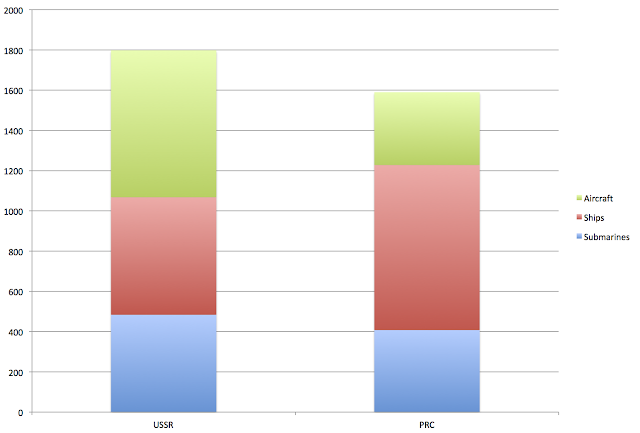
One of the best uses of history is to gain perspective on the present. Today, there is much talk in naval circles about A2/AD environments and the antiship missile threat in a potential war with China. However, there is surprisingly little reference to the very similar threat the Soviet Navy posed not so long ago. This comparison is particularly apt as the maritime strategies of the USSR of 1988 and the PRC of 2018 have much in common. Both were primarily land powers that had developed a defensive navy with significant blue water reach. In 1988, the Soviet Navy fielded a force of 64 submarines, 85 surface ships, and roughly 365 bombers equipped with some 1798 antiship missiles. In comparison, the Chinese Navy of 2018 has 48 submarines, 112 surface ships, and roughly 180 bombers and fighters that carry around 1590 missiles. While both navies also fielded missile craft and shore launchers, platforms of this nature cannot seriously contesting sea control and will be excluded from this...