Posts

Showing posts with the label Weapons Development

Japanese Interwar Antiaircraft Guns (1916-1939)

The World War II ships of the Imperial Japanese Navy are often criticized for their inadequate air defense armament. Now, this critique is somewhat arguable for a variety of reasons, but this post is instead going to look at the more neglected subject of how Japanese air defense guns reached the point they were at when the war began. Popular military history loses a lot of context by focusing on wars rather than peacetime developments, and nowhere is that more true than in the subject of aircraft World War II. It must always be remembered that aircraft evolved rapidly over the interwar period and much of what they accomplished during World War II would have been impossible just a few years earlier. Contrary to popular belief, the major navies of the world were quite forward-looking when it came to aircraft, and this includes the matter of air defense. The Royal Navy introduced its first dedicated antiaircraft gun (the 12 pounder QF HA Mk 1) in 1913, and the Imperial German Navy and U...

Scouting At Sea (1890-2018)

Image
Naval warfare occurs across vast distances and in many cases merely finding the enemy is a complex and critical task. Over the past century, scouting has been performed by a variety of systems from steam cruisers to UAV's. A look at the changes reveals both the early acceptance of naval airpower as well as yet another example of the gradual shift from platforms to systems. Early Steam Fleet operations in late 19th century differed little from those of the Napoleonic wars. There were no aircraft or radios and even electric lighting was still a novel technology. The most advanced sensor system was a lookout with binoculars and communications were limited to signal flags, lights, and semaphore. In that time, scouting was performed by a screen of 2nd class cruisers operating ahead of the battleline, much like the frigates of Nelson's day. The protected cruiser HMS Retribution These ships were generally capable of around 20 knots, but their triple expansion engines were unr...

Soviet Naval Antiship Missiles of the Cold War: 1957-1991

Image
An SS-N-22 Sunburn supersonic antiship missile The antiship missile was pioneered by the United States and Germany. Both nations tested experimental weapons during World War I and then deployed operational weapons during World War II. However, all of these were air launched missiles. While the United States Navy made major advances in ship and submarine launched weapons in the post war period, it did not field any antiship weapons on these platforms - probably because of both a lack of suitable targets and satisfaction with its existing antiship weapons.  In contrast, when World War II ended the Soviet Navy was in desperate need of powerful antiship weapons. Its small force of torpedo boats, destroyers, and light cruisers now faced an overwhelmingly powerful American Navy whose carriers and cruisers were armed with nuclear weapons for use against targets far inland. While the Soviet Union developed and deployed large numbers of air launched antiship missiles, it also pio...

The Tomahawk Missile and the Land Attack Revolution: 1980-1990

Image
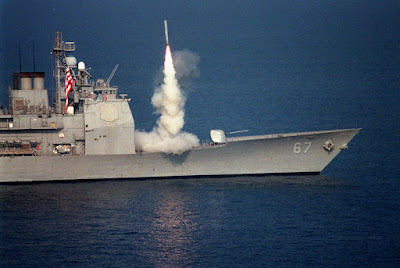
Tomahawk is fired from a Ticonderoga-class cruiser Since Desert Storm in 1991, the Tomahawk cruise missile has become the signature weapon of the United States. Fired during operations in Iraq, Afghanistan, Sudan, Bosnia, Somalia, Libya, Yemen, and most lately Syria, it has become a rare military operation that does not include a salvo of Tomahawks launched from Navy ships offshore. However, in 1980, when the first Tomahawk was fired from a surface combatant at sea, such a capability was unimaginable. Land Attack Before Tomahawk The United States Navy began experimenting with ship launched land attack missiles as part of its extensive guided missile research during World War II. The final product of these early efforts was the SSM-N-8 Regulus, a large subsonic cruise missile with a range of 500 miles and a 40 kiloton nuclear warhead. It was declared operation in 1954 and by 1957 16 ships (including 10 carriers, four cruisers, and two submarines) had been modified to carry it. ...

Bumblebee, Lark, and Little Joe: US Navy Guided Missiles 1944-1955

Image
RIM-8 Talos Today guided missiles are an integral part of the United States Navy and warships armed with the Aegis combat system are considered the pinnacle of surface combatant development. However, unlike most new weapons systems, the naval guided missile was not the result of incremental advances over time. Instead, it was the result a decade long project designed to create the theoretical weapon that was deemed necessary to counter an emerging threat. The First Naval Missiles While rockets have been a part of warfare for centuries (British ship-launched Congreve rockets are immortalized in the American national anthem), they had always been inaccurate ballistic devices that were clearly inferior to guns. This changed with the introduction of aircraft and the development of radio at the end of the 19th century. Suddenly it became possible to construct a missile (not necessarily a rocket) that could not only change course in flight, but receive targeting information and cour...