Posts

Showing posts with the label Fighter Aircraft

World Aircraft Carriers (1951 - 2020)

Image
All non-US carriers operating fixed-wing aircraft (click to enlarge) The aircraft carrier has been the ultimate expression of naval power since World War II. Able to engage air, surface, and subsurface targets from hundreds of miles away, the carrier is a highly versatile class of warship and even a small number of carriers can turn the tide of an entire war. However, these ships (and the aircraft that they carry) are extremely expensive and only a handful of navies have ever operated them. Since the end of World War II, only 14 nations have operated a carrier with fixed-wing aircraft and no more than 9 nations have done so simultaneously. The above chart covers all non-US aircraft carriers operating fixed-wing aircraft from 1951-2020. I have not only excluded helicopter carriers, but also attempted to avoid counting commissioned ships that did not have available aircraft (for instance, I did not count the Soviet Kiev-class ships after 1991, when their Yak-38 fighters were phased out)...
World Carrier Air Wings (2019): Part 2

Image
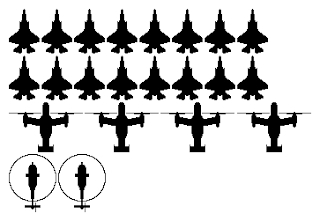
While Part 1 of this series dealt with the powerful CATOBAR and STOBAR carriers, this part covers the less capable VSTOL carriers. Although VSTOL ships are much less complicated and can be significantly smaller, the selection of VSTOL fighter aircraft is extremely limited and the reliance on vertical landings places further restrictions on aircraft operations. Wasp-class & America-class Ironically, the most powerful VSTOL airwing does not belong to an aircraft carrier at all, but to the eight  Wasp -class and single  America -class amphibious assault ships of the United States Navy. Although these flat-decked 257-meter ships may resemble carriers, they are primarily designed to transport and land large numbers of Marines and their equipment. This resulted in several design tradeoffs that limit their ability to conduct fixed-wing operations, such as a lack of a ski-jump, smaller maintenance facilities, and reduced magazine and fuel capacity. While the aviation facilities...

World Carrier Air Wings (2019): Part 1

Image
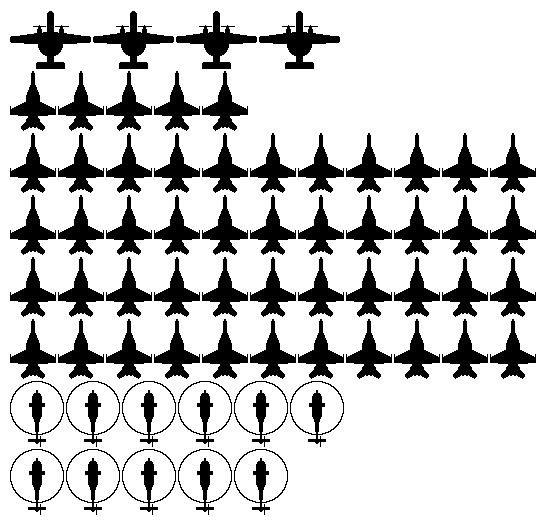
This post will cover the composition of the air wings of the world's current major aircraft carriers. This includes the American Nimitz -class, the French Charles de Gaulle , the Chinese Liaoning , the Indian Vikramaditya , and the Russian Kuznetsov . The air wings of the smaller VSTOL are covered in Part 2 . Nimitz-class The uncontested apex of carrier air wings is found aboard the United State’s 10 Nimitz -class carriers (the Gerald Ford -class will carry the same air wing, although the lead ship is not yet operational). These ships generally operate 64 aircraft, twice as many as their competitors. Further, unlike almost all non-American carriers, the Nimitz-class is equipped for catapult takeoff and arrested recovery (CATOBAR), permitting the operation of heavy aircraft with full loads of weapons and fuel. 2019 Nimitz-class air wing: 4x E-2D, 5x EA-18G, 44x F/A-18E/F, 11x MH-60R/S Arguably the most important aircraft in this air wing are its 4 the E-2 Hawkeye 29-ton fi...

Post WWII USN Carrier Fighters (1945-2018)

Image
Unlike my recent post on USN Carrier Aircraft of the Korean War ,  this is not intended to be a detailed look at the individual aircraft types, but an overview of the timeline and production numbers to reveal larger trends. For simplicity's sake I will only be covering operational aircraft produced in reasonable numbers and ignoring early types such as the FH or F6U. I will also not be considering non-fighter variants such as photo-recon planes. Gold represents years in production while blue represents years in service. Note: FJ does not include the FJ-1 As is well known, as time passed fewer aircraft were developed and those that were remained in service longer. However, somewhat unexpectedly, this change does not appear to have been a gradual one. Instead, there was an explosion of new aircraft when the jet age began, but after a decade things had slowed down to something similar to the modern pace of development. From the F9F Panther to the F11F Tiger, fighters remai...

The F-111B: A Missed Opportunity? (1961-1968)

Image
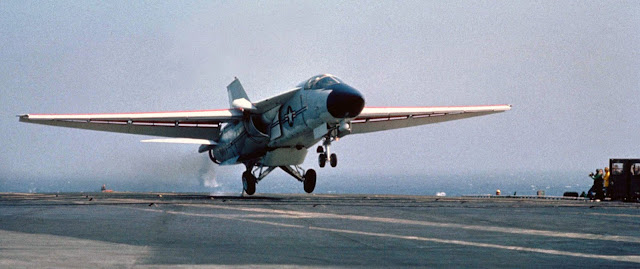
A prototype F-111B lands on USS Coral Sea (CV-43) during carrier trials in 1968 The saga of the F-111 is well known. In the late 1960’s, the United States Air Force and United States Navy were both looking for a new tactical fighter and the Department of Defense mandated that they cooperate and develop a single airframe with variants for both services. The Air Force variant, a low-level attack plane, entered service in 1967 as the F-111A Aardvark. Fast, long-ranged, and equipped with sophisticated electronics, the F-111A and its later versions served with distinction from the Vietnam War to Operation Desert Storm. It also was modified into a highly effective electronic warfare plane (the EF-111) and Strategic Air Command even operated a version (the FB-111) as a nuclear bomber. However, the Navy’s F-111B variant, a long-range interceptor, was cancelled in 1968 after only seven prototypes had been built. The stated reasons for this cancellation was that the plane was too heavy, u...

USN Carrier Aircraft of the Korean War (1950-1953)

Image
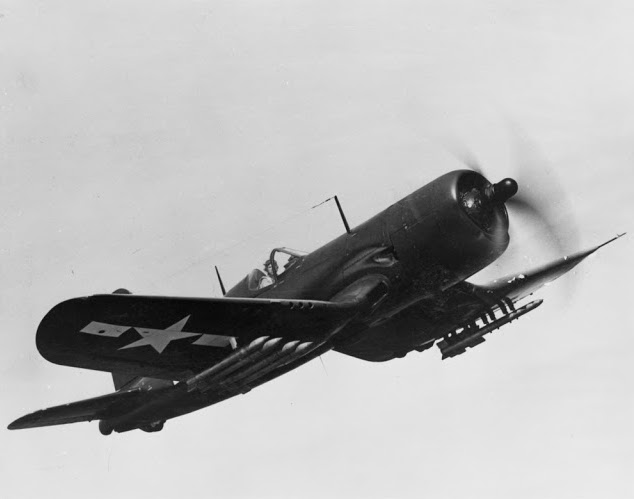
During the Korean War, military technology was in a transitional state. While a whole generation of more modern weapons had been developed, the large inventory of World War II weapons and the post-war Truman budget cuts meant that old and new operated side by side throughout the conflict. This can be clearly seen in the Navy's aircraft, where WWII propellor planes operated with jets and helicopters. This post will provide a brief overview of every aircraft variant that served aboard the newly redesignated attack carriers during the Korean War. An F4U-4 Corsair armed with eight 5" rockets The F4U Corsair Fighter The F4U-4 Corsair was the single most common carrier aircraft in the Korean War. Designed as a high-performance fighter during World War II, by 1950 its top speed of 390 knots and service ceiling of 41,000 feet was decidedly outclassed by the jet fighters that were then in service. However, large numbers were available and its six internal .50 machine guns with 2...

Procurement Perspective: F-35C Lightning vs F/A-18E/F Super Hornet

Image
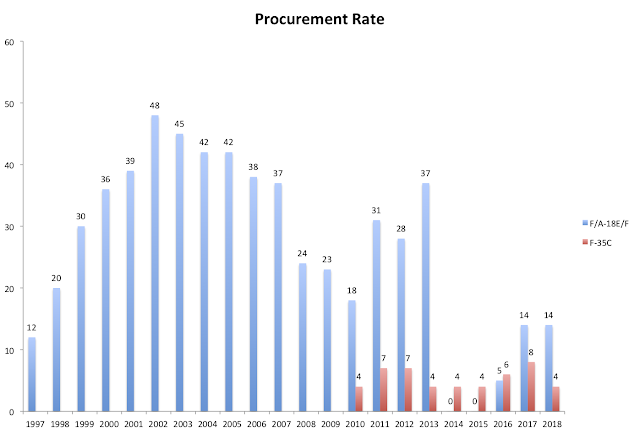
The F-35 Lightning II Joint Strike Fighter is certainly one of today's most controversial procurement programs and is widely criticized for its extreme cost. In contrast, the F/A-18E/F Super Hornet is widely touted as an example of cost management and military procurement done right. But what happens if you dig a little deeper into the history of these two programs? The first thing that must be done is to understand the timelines of the two programs. Because both aircraft are currently being procured (the FY2019 Navy budget requests twenty four Super Hornets and nine Lightnings), there is a tendency to think of the two planes as near contemporaries. However, this is far from true. The first F/A-18E/F prototype was ordered in 1992 and made its first flight in 1995, while for the F-35C those dates were 2007 and 2010. Procurement of both aircraft began in the same year that the prototype first flew. To put this into perspective, fifteen years separated the first flights of the Sup...