Posts

Missile Loadouts: USN Missile Cruisers (1959-1999)

Image
After the initial introduction of guided missile systems on converted gun cruisers, it became clear that a new type of warship was needed as the existing designs were either too small or unnecessarily large. These new ships were assigned the hull designation DLG and dubbed “frigates” after the famous sailing ships such as USS Constitution. That the USN applied this name to powerful guided missile ships while the European navies used it to refer to cheap submarine hunters reflects a historic difference - in the nineteenth century, the frigates were the most powerful vessels in the small American navy, while in Europe the frigates were seen as minor combatants that lived in the shadow of the ships of the line. However, the American use of this term did not survive long, and, in 1975, the USN dropped the DLG designation as part of a wider simplification of its hull numbers. The frigates were redesignated as either cruisers (CG) or destroyers (DDG). Simultaneously, the ocean escorts (DE)...

Standard Missile 2 Midcourse Guidance

Image
The RIM-66 SM-2MR in its boost phase One of the less appreciated aspects of naval warfare is how the same weapon can have rather different capabilities depending on the combat system controlling it. The neglect of this point is somewhat remarkable given that the importance of combat systems was made obvious well over a hundred years ago with the introduction of centralized fire control. But this post is about the RIM-66/RIM-67/RIM-156 SM-2 - the mainstay of Western naval air defense. This missile has been integrated with a variety of combat systems including Aegis, Terrier, and Tartar, as well as several foreign systems, but it actually functions in rather different ways depending on which system is controlling it. As is widely known, SM-2 represented a massive advance over its predecessor (SM-1) because of its use of a programmable autopilot. This allowed SM-2 to fly a more efficient ballistic trajectory, almost doubling its range, as well as time share illuminators, allowing a...

Understanding JMSDF Hull Numbers

Image
A JMSDF Helicopter Destroyer (140-series hull number) and Missile Boat (800-series hull number) The JMSDF utilizes a hull designation system that is on the surface quite similar to that of the USN. However, a second look will reveal that it does not follow the same rules. Hull designations are not unique (there have been two of DD-101 through DD-119) and numbers are assigned out of order (DD-101 immediately followed DD-158). But on closer examination, one will discover that it actually conveys more information than the USN system. The principle that must be remembered is that, in contrast with the USN, it is the numbers that are the key while the letters are actually somewhat redundant. All JMSDF ships, regardless of letter designations, follow the same set of rules for number designations. The first rule is that the leading digit of a ship’s number (when combined with the total number of digits) reveals her general class - for instance, all destroyers have a number in the 100 r...

Looking for the Average Frigate (2018)

Image
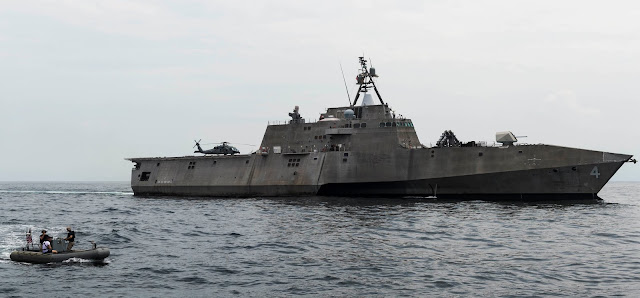
USS Coronado (LCS-4) conducting training off Malaysia in 2017 I recently decided to look at the armament of all the world’s frigates and here are the results. First, some notes on methodology. I took frigate to mean warships of between 100 and 150 meters in length. While these numbers and form of measurement are somewhat arbitrary, so are all forms of ship classification and this range seems to fit fairly well. The definition of warship is more difficult. I only included ships operated by navies (no coast guards) and tried to exclude pure patrol ships. However, the line between an OPV and a frigate is somewhat blurry and there were several judgement calls involved. The same can be said about my dividing surface to air missiles into three categories. While some differentiation was obviously necessary as a Crotale and an Aster 30 are definitely not comparable, deciding which category a particular missile falls into is not clear cut. I generally stuck with point defense missiles ...

Missile Loadouts: American Cold War Missile Destroyers (1956-1999)

Image
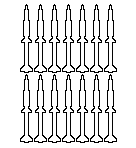
Gyatt (DDG-1) The United States Navy’s first guided missile destroyer was the converted  Gearing -class destroyer  Gyatt (originally given the designation DDG-712 during her conversion, she was renumbered DDG-1 five months after recommissioning). Gyatt rejoined the fleet in 1956 with a Mk8 twin arm Terrier launcher and a fourteen round magazine replacing her torpedoes and aft 5" mount. However, she was always something of a test platform to determine the practicality of putting missiles on destroyers and in 1962, just six years after recommissioning, the Terrier launcher was removed and Gyatt reverted to her original destroyer designation Gyatt (DDG-712) in 1956: 14x Terrier Charles F. Adams-class While Gyatt conversion had tried to put too big a missile on too small a ship, the Navy still desired guided missile destroyers and the development of the smaller Tartar missile made it possible. The first purpose built guided missile destroyers were the Charles F. Adams -...

France Joins the Club

Image
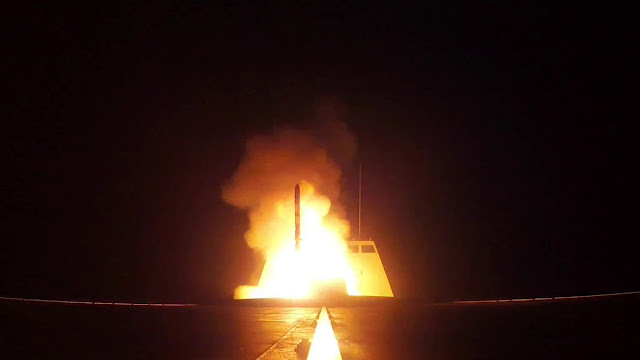
In flurry of articles surrounding last night's strikes on Syria, I noticed that a fairly important point has been largely missing from the coverage - it marked the first time France has fired naval land attack missiles in anger. Although the French naval contribution of just three missiles fired from the frigate Languedoc was rather small when compared to the dozens of Tomahawks fired from multiple American ships, it was still a major landmark for both the Marine Nationale and naval warfare as a whole. Despite the fact that the United States Navy first used land attack missiles to devastating effect during the Gulf War back in 1991, the rest of the world's navies have been remarkably slow to obtain this revolutionary capability. The Royal Navy was the second to do so, and fired land attack missiles at Kosovo in 1999. However, its capability has always been limited to a small number of submarine launched Tomahawks purchased from the United States. It was not until 2015, and ...

Procurement Perspective: F-35C Lightning vs F/A-18E/F Super Hornet

Image
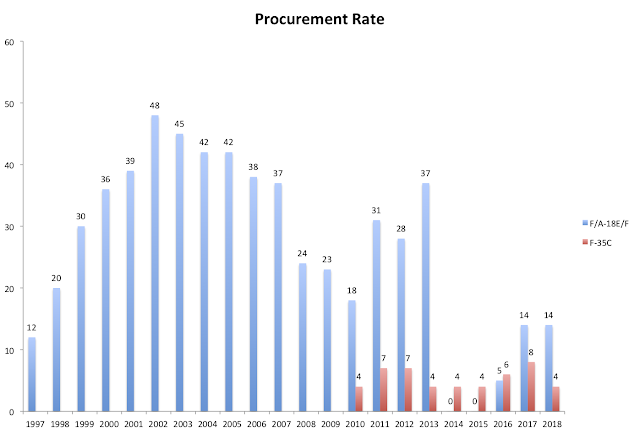
The F-35 Lightning II Joint Strike Fighter is certainly one of today's most controversial procurement programs and is widely criticized for its extreme cost. In contrast, the F/A-18E/F Super Hornet is widely touted as an example of cost management and military procurement done right. But what happens if you dig a little deeper into the history of these two programs? The first thing that must be done is to understand the timelines of the two programs. Because both aircraft are currently being procured (the FY2019 Navy budget requests twenty four Super Hornets and nine Lightnings), there is a tendency to think of the two planes as near contemporaries. However, this is far from true. The first F/A-18E/F prototype was ordered in 1992 and made its first flight in 1995, while for the F-35C those dates were 2007 and 2010. Procurement of both aircraft began in the same year that the prototype first flew. To put this into perspective, fifteen years separated the first flights of the Sup...