Posts

What Went Wrong With LCS? US Frigate Production (1969-2019)

Image
Oliver Hazard Perry (FFG-7) under construction at Bath Iron Works in 1976 The United States Navy's Littoral Combat Ship program has come under extreme criticism from every side. Personally, I find much of the vitriol to be incredibly shallow and misinformed and believe that the program is actually a worthy endeavor. However, there is one clear failing of the program that I have seen virtually no comment on - it's glacial build rate. I have touched on the topic of the slow procurement of modern systems before, in my post comparing the production of the F-35 Lighting and the F/A-18 Super Hornet , and I believe it is important to come back to it in regards to the LCS program. It is well known be anyone with even a passing familiarity with shipbuilding that protracted construction of limited quantities inevitably drives up costs. However, in all the discussion of the possible reasons behind the price tag of LCS (which I personally believe is far from being as outrageous as ma...
The Japanese Carrier Force in WWII (1941-1945)

Image
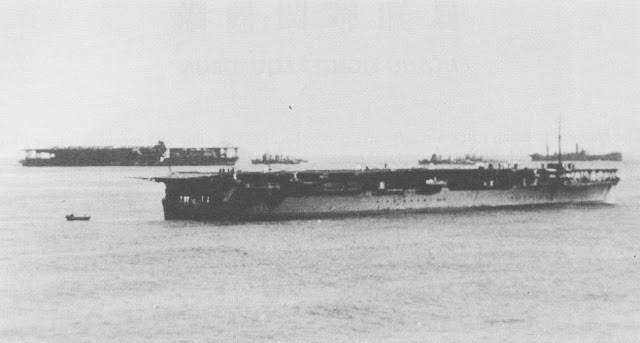
Kaga and Hosho at anchor prior to the Second World War Japan entered the Second World War with a force of ten carriers, while the United States and Great Britain each had seven. However, four of the Japanese ships were light carriers while all seven American ships were fleet carriers, meaning that despite the difference in numbers both carrier forces could accommodate roughly 600 aircraft. In Britain's case all seven of her ships were light carriers and could only accommodate a total of less than 300 aircraft. Japanese Carrier Force 12/1941 (capacity of 600 aircraft): Hosho - 168 meters, 25 knots, 20 aircraft Akagi - 261 meters, 31 knots, 90 aircraft (battlecruiser hull) Kaga - 248 meters, 28 knots, 90 aircraft (battleship hull) Ryujo - 180 meters, 29 knots, 40 aircraft Soryu - 228 meters, 34 knots, 70 aircraft Hiryu - 227 meters, 34 knots, 70 aircraft Zuiho - 217 meters, 28 knots, 30 aircraft (converted submarine tender) Shokaku - 258 meters, 34 knots, 80 aircraft Z...

Missile Loadouts: Spruance-class Destroyers (1975-2005)

Image
The Spruance -class destroyers have probably the most complex missile loadout history of any non-air defense ship. Unfortunately, the numerous changes and variation have surprisingly little available documentation and I have been forced to rely heavily on photographs to fill in the gaps. Therefore, many of the dates in this post are only estimates. The Spruance -class was designed during the late 1960’s as a modern warship to replace the large number of WWII-era Fletcher , Allen M Sumner , and Gearing -class class destroyers that were swiftly becoming obsolete. Force structure analysis during the design process revealed that while air defense systems significantly increased unit cost, it was ASW that drove force size requirements. Therefore, it was decided to supplement DDG and DLG production with a more affordable DD design that eventually became the Spruance -class. In a drive for greater efficiency, the DD would also share its hull with a DDG design. While the related DDG was neve...

World Carrier Air Wings (2019): Part 2

Image
While Part 1 of this series dealt with the powerful CATOBAR and STOBAR carriers, this part covers the less capable VSTOL carriers. Although VSTOL ships are much less complicated and can be significantly smaller, the selection of VSTOL fighter aircraft is extremely limited and the reliance on vertical landings places further restrictions on aircraft operations. Wasp-class & America-class Ironically, the most powerful VSTOL airwing does not belong to an aircraft carrier at all, but to the eight  Wasp -class and single  America -class amphibious assault ships of the United States Navy. Although these flat-decked 257-meter ships may resemble carriers, they are primarily designed to transport and land large numbers of Marines and their equipment. This resulted in several design tradeoffs that limit their ability to conduct fixed-wing operations, such as a lack of a ski-jump, smaller maintenance facilities, and reduced magazine and fuel capacity. While the aviation facilities...

World Carrier Air Wings (2019): Part 1

Image
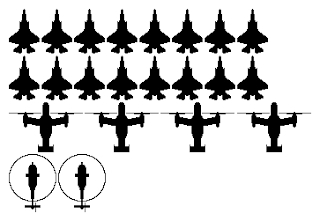
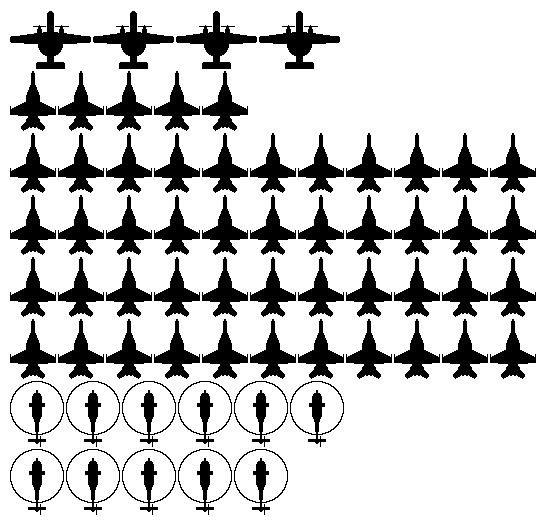
This post will cover the composition of the air wings of the world's current major aircraft carriers. This includes the American Nimitz -class, the French Charles de Gaulle , the Chinese Liaoning , the Indian Vikramaditya , and the Russian Kuznetsov . The air wings of the smaller VSTOL are covered in Part 2 . Nimitz-class The uncontested apex of carrier air wings is found aboard the United State’s 10 Nimitz -class carriers (the Gerald Ford -class will carry the same air wing, although the lead ship is not yet operational). These ships generally operate 64 aircraft, twice as many as their competitors. Further, unlike almost all non-American carriers, the Nimitz-class is equipped for catapult takeoff and arrested recovery (CATOBAR), permitting the operation of heavy aircraft with full loads of weapons and fuel. 2019 Nimitz-class air wing: 4x E-2D, 5x EA-18G, 44x F/A-18E/F, 11x MH-60R/S Arguably the most important aircraft in this air wing are its 4 the E-2 Hawkeye 29-ton fi...

Aircraft Carrier Costs: Nimitz vs Ford

Image
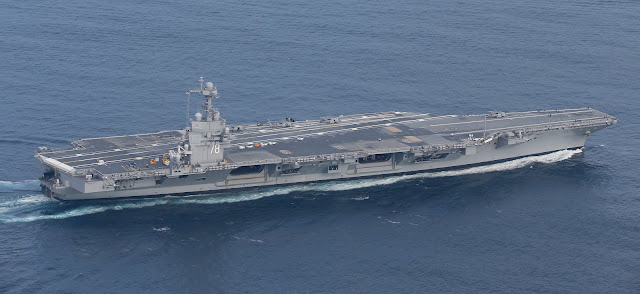
The much-maligned USS Gerald Ford (CVN-78) The United States Navy's new Gerald Ford -class aircraft carriers, like virtually all modern military equipment, have come under intense criticism for their supposedly exorbitant cost. Accusations of their costing 2-3 times as much as their predecessors, the venerable  Nimitz -class have been thrown around and many believe that the Navy would have been better off not developing the Gerald Ford -class. However, I believe these criticisms are entirely unjustified and (as with the F-35, which I previously wrote about ) stem from the media's ignorant if not outright dishonest use of non-comparable costs and a poor understanding of timelines. When put into proper context, I believe that the ships of the  Gerald Ford -class are actually only marginally more expensive than those of the Nimitz -class. First the numbers. The Navy's budget submissions reveal the exact costs of three carriers: the final member of the  Nimitz -clas...

FY2020 US Navy Budget Highlights

The recent United States Navy Fiscal Year 2020 budget proposal has unleashed the usual flurry of articles analyzing and discussing its ramifications. However, while the vast majority of these have focused on the same details, particularly the proposed early retirement of USS Harry Truman (CVN-75) and the introduction of large unmanned surface vessels, I will instead point out various minor pieces of information that have caught my eye. Missiles The greatest change is that antiship missiles are indeed back with a vengeance. In FY20, the Navy is proposing to procure no fewer than 216 antiship missiles of 5 different types and has stated a desire for an overall inventory of over 2000 dedicated antiship missiles. This is quite obviously aimed at the rapidly growing Chinese Navy. However, by my rough estimation, this is actually enough weapons to sink every non-US warship in the word twice over. Tomahawk Tomahawk production is restarting after a lapsing for FY19. A total of 180 weapon...