Posts

Missile Loadouts: British Air Warfare Ships (1962-2026)

Image
The County-class Unlike most navies, the Royal Navy's first guided missile ships were not conversions of existing ships. Instead, they were the eight purpose-built  County -class destroyers, which entered service beginning in 1962. Measuring 158 meters in length, these ships were much larger than the proceeding 120-meter Daring -class gun destroyers and were commonly referred to as "DLG" after the American hull code for large missile ships like the contemporary Farragut -class frigates . Further, rather than relying on American missiles as was done by most NATO navies, the British chose to build the County -class around the domestic Sea Slug surface-to-air missile - a weapon that unfortunately lived up to its underwhelming name. A beam riding missile with a range of 25 kilometers and a top speed of Mach 1.5 (many sources state Sea Slug was subsonic, this is incorrect and likely a misreading of the fact that it could only engage subsonic targets), Sea Slug was comparable...

What Went Wrong With LCS? US Frigate Production (1969-2019)

Image
Oliver Hazard Perry (FFG-7) under construction at Bath Iron Works in 1976 The United States Navy's Littoral Combat Ship program has come under extreme criticism from every side. Personally, I find much of the vitriol to be incredibly shallow and misinformed and believe that the program is actually a worthy endeavor. However, there is one clear failing of the program that I have seen virtually no comment on - it's glacial build rate. I have touched on the topic of the slow procurement of modern systems before, in my post comparing the production of the F-35 Lighting and the F/A-18 Super Hornet , and I believe it is important to come back to it in regards to the LCS program. It is well known be anyone with even a passing familiarity with shipbuilding that protracted construction of limited quantities inevitably drives up costs. However, in all the discussion of the possible reasons behind the price tag of LCS (which I personally believe is far from being as outrageous as ma...

The Japanese Carrier Force in WWII (1941-1945)

Image
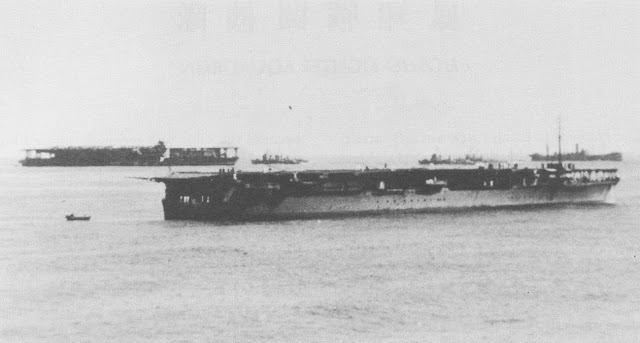
Kaga and Hosho at anchor prior to the Second World War Japan entered the Second World War with a force of ten carriers, while the United States and Great Britain each had seven. However, four of the Japanese ships were light carriers while all seven American ships were fleet carriers, meaning that despite the difference in numbers both carrier forces could accommodate roughly 600 aircraft. In Britain's case all seven of her ships were light carriers and could only accommodate a total of less than 300 aircraft. Japanese Carrier Force 12/1941 (capacity of 600 aircraft): Hosho - 168 meters, 25 knots, 20 aircraft Akagi - 261 meters, 31 knots, 90 aircraft (battlecruiser hull) Kaga - 248 meters, 28 knots, 90 aircraft (battleship hull) Ryujo - 180 meters, 29 knots, 40 aircraft Soryu - 228 meters, 34 knots, 70 aircraft Hiryu - 227 meters, 34 knots, 70 aircraft Zuiho - 217 meters, 28 knots, 30 aircraft (converted submarine tender) Shokaku - 258 meters, 34 knots, 80 aircraft Z...

Missile Loadouts: Spruance-class Destroyers (1975-2005)

Image
The Spruance -class destroyers have probably the most complex missile loadout history of any non-air defense ship. Unfortunately, the numerous changes and variation have surprisingly little available documentation and I have been forced to rely heavily on photographs to fill in the gaps. Therefore, many of the dates in this post are only estimates. The Spruance -class was designed during the late 1960’s as a modern warship to replace the large number of WWII-era Fletcher , Allen M Sumner , and Gearing -class class destroyers that were swiftly becoming obsolete. Force structure analysis during the design process revealed that while air defense systems significantly increased unit cost, it was ASW that drove force size requirements. Therefore, it was decided to supplement DDG and DLG production with a more affordable DD design that eventually became the Spruance -class. In a drive for greater efficiency, the DD would also share its hull with a DDG design. While the related DDG was neve...

World Carrier Air Wings (2019): Part 2

Image
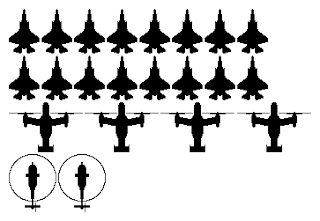
While Part 1 of this series dealt with the powerful CATOBAR and STOBAR carriers, this part covers the less capable VSTOL carriers. Although VSTOL ships are much less complicated and can be significantly smaller, the selection of VSTOL fighter aircraft is extremely limited and the reliance on vertical landings places further restrictions on aircraft operations. Wasp-class & America-class Ironically, the most powerful VSTOL airwing does not belong to an aircraft carrier at all, but to the eight  Wasp -class and single  America -class amphibious assault ships of the United States Navy. Although these flat-decked 257-meter ships may resemble carriers, they are primarily designed to transport and land large numbers of Marines and their equipment. This resulted in several design tradeoffs that limit their ability to conduct fixed-wing operations, such as a lack of a ski-jump, smaller maintenance facilities, and reduced magazine and fuel capacity. While the aviation facilities...

World Carrier Air Wings (2019): Part 1

Image
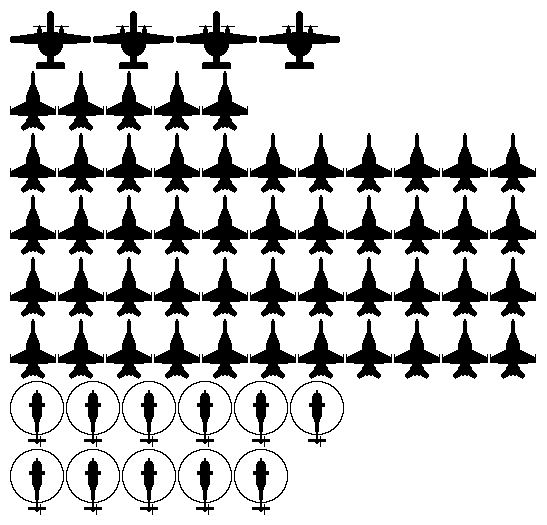
This post will cover the composition of the air wings of the world's current major aircraft carriers. This includes the American Nimitz -class, the French Charles de Gaulle , the Chinese Liaoning , the Indian Vikramaditya , and the Russian Kuznetsov . The air wings of the smaller VSTOL are covered in Part 2 . Nimitz-class The uncontested apex of carrier air wings is found aboard the United State’s 10 Nimitz -class carriers (the Gerald Ford -class will carry the same air wing, although the lead ship is not yet operational). These ships generally operate 64 aircraft, twice as many as their competitors. Further, unlike almost all non-American carriers, the Nimitz-class is equipped for catapult takeoff and arrested recovery (CATOBAR), permitting the operation of heavy aircraft with full loads of weapons and fuel. 2019 Nimitz-class air wing: 4x E-2D, 5x EA-18G, 44x F/A-18E/F, 11x MH-60R/S Arguably the most important aircraft in this air wing are its 4 the E-2 Hawkeye 29-ton fi...